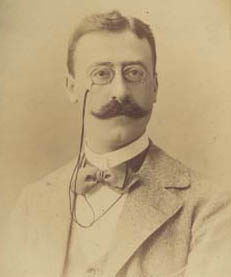
February 27, 1865 – February 23, 1954
Jacques Mieses belongs to the most remarkable personalities in German chess history. With an active tournament career spanning almost seven decades, he still holds the record for the longest career of any chess master.
He was born as Jakob Mieses in Leipzig, son of a Jewish merchant family originally from Brody – a city that then belonged to Austria-Hungary and is now in Ukraine. Chess was in the family's blood, so to speak: His uncle Samuel Mieses had learned the royal game from none other than Adolf Anderssen personally, and his cousin Viktor also made a name for himself as a chess problem composer.
Early Years and Education
Jacques Mieses first attended the civic school at Augustusplatz in Leipzig, later the renowned Thomasgymnasium. His father Julius reported in his records that young Jacques had initially been a "lively whirlwind" who demanded quite a lot from his teachers. But in the higher grades, the picture changed: With excellent comprehension and talent, he graduated cum laude and even received a prize.
After gymnasium, Mieses studied natural sciences – physics and chemistry – at the universities of Leipzig and Berlin. But academic life could not captivate him permanently. Chess, which he had devoted himself to since his fifteenth year, was to become his true life's work.
"He also learned Gabelsberger stenography, became an excellent stenographer, also learned various games easily, especially the serious game of chess, in which he excelled remarkably."
The Path to Chess Mastery
Mieses' first master tournament was in 1888 at the 40th Jubilee Tournament of the Schachgesellschaft Augustea in Leipzig, where he finished third behind von Bardeleben and Riemann. In his early years, Mieses was also active as a chess problem composer and was regarded as a phenomenal problem solver. This marked the beginning of a career that would span nearly seven decades. Initially earning his living as a "professional player," he later transformed into a "professional writer," producing 76 chess publications throughout his lifetime.
His literary output was remarkable: from instructional books to tournament reports, from problem collections to theoretical works. The most famous was his continuation of Jean Dufresne's "Lehrbuch des Schachspiels" (Textbook of Chess), which he maintained for over 50 years and which remains one of the most successful chess textbooks worldwide.
The Royal Game
Mieses was the last prominent representative of the romantic chess school of the 19th century. His attacking spirit, tactical brilliance, and combinative genius made him a dangerous opponent even for the world's strongest players. He was known for his spectacular short games and earned more brilliancy prizes than almost any other player of his era.
Mieses also left his mark on opening theory, with one first move and three variations carrying his name. The Mieses Opening is 1.d3 (ECO A00) – a waiting move with a purpose, playable but unambitious; Garry Kasparov opened game three of his 1997 match against Deep Blue with it, hoping to drag the machine out of its opening book. The variations are the Mieses Variation in the Vienna Game (1.e4 e5 2.Nc3 Nf6 3.g3, ECO C26), the Mieses Variation in the Scotch Game (after 5.Nxc6 bxc6 6.e5, ECO C45), which he first played at Hastings 1895, and the Mieses-Kotrč Variation in the Scandinavian Defense (1.e4 d5 2.exd5 Qxd5 3.Nc3 Qa5 4.d4 Nf6, ECO B01).
Mieses in Popular Culture
Jacques Mieses is mentioned by name in Walter Tevis' bestselling novel The Queen's Gambit (1983). In the award-winning Netflix adaptation (2020), a position from his game against Reshevsky (Margate 1935) is featured in Episode 3 when the character Benny Watts is introduced.
As Author and Journalist
Alongside his playing career, Mieses became one of the most prolific chess writers of his generation. The German National Library catalogues 76 publications under his name — more than Lasker and Tarrasch produced together — which consolidate to some 45 distinct titles across more than 95 editions and printings.
His flagship was Jean Dufresne's Lehrbuch des Schachspiels (Textbook of Chess). After Dufresne's death the Leipzig publisher Reclam engaged Mieses to continue it; his first revised edition appeared in 1901. The book outlived them both and stayed in print for more than 120 years. Alongside it he wrote chess columns for the Berliner Tageblatt, the Leipziger Neueste Nachrichten and the illustrated weekly Zur Guten Stunde.
International Career
During his long career, Mieses faced practically all the great masters of his time, including world champions Steinitz, Lasker, Capablanca, Alekhine, and Euwe. He defeated several of the era's other leading masters, among them Tarrasch, Marshall and Rubinstein. His greatest tournament success came in 1907 when he won the first Trebitsch Memorial in Vienna.
- 1882: Winter Tournament of the Schachgesellschaft Augustea, Leipzig (1st place)
- 1888: Leipzig, Augustea Jubilee Tournament (3rd place)
- 1895: Hastings (shared 20th–21st place)
- 1897: Berlin (shared 3rd–4th place)
- 1903: Monte Carlo (8th place)
- 1904: Cambridge Springs (8th–9th place)
- 1907: Vienna, Trebitsch Memorial (1st place)
- 1907: Ostend, Masters Tournament (3rd–4th place)
- 1911: San Sebastián (tournament director)
- 1923: Liverpool (1st place)
- 1925: Baden-Baden (19th place)
- 1927: London, 1st Chess Olympiad (Board 2 for Germany)
- 1946: Hastings (brilliancy prize at age 80!)
- 1948: Stockholm (shared 3rd–5th place at age 82)
The Organizer: San Sebastián 1911
Mieses' most lasting contribution away from the board came in 1911. As tournament director at San Sebastián he persuaded the sponsor to reimburse the players' travel costs and to provide free board and lodging — until then masters had largely paid their own way to a tournament. The custom of "hospitality" spread from there. The same tournament gave José Raúl Capablanca his European breakthrough: the young Cuban won it at his first appearance in Europe.
Simultaneous and blindfold displays were the other half of a touring professional's income, and Mieses gave them across Europe throughout his career.
Emigration
Until he emigrated, Mieses lived at Christianstraße 19 in Leipzig. After the Nazi regime excluded Jewish players from German chess life in 1933, he left for England in 1938 at the age of 73, with only 15 Reichsmarks in his pocket. He rebuilt his life and became a British citizen in 1947. From 1935 onwards, Mieses had worked as chess correspondent for Britain's Reuters agency — a connection that explains his seamless integration into English chess journalism after his 1938 escape.
The Later Years
Even in his eighties, Mieses remained remarkably active. At the Hastings tournament in 1946, at age 80, he won the brilliancy prize. Two years later, at 82, he finished a shared 3rd–5th in Stockholm. His tournament career — from his first known tournament in 1882, through his international debut in 1888, to his last tournament in 1949/50 — remains the longest chess career in history, a record that stands to this day. His vitality was legendary: he exercised daily, swam regularly even at 86, and did push-ups in Hyde Park.
When FIDE established the Grandmaster title in 1950, Mieses was among the 27 original recipients – the oldest chess grandmaster of them all. As a naturalized British subject he was thereby, technically, the first British grandmaster; the first British-born one was Tony Miles, 26 years later. He continued to play and teach until shortly before his death on February 23, 1954, at a London nursing home, just four days before his 89th birthday.
- Nearly seven decades of active tournament play (1882–1950) – unmatched to this day
- Over 60 tournaments and more than 20 matches
- Oldest grandmaster among the first FIDE title awards in 1950
- Brilliancy prize at age 80 at the Hastings tournament in 1946
Mieses was also known for his sharp wit. When someone mispronounced his name and called him “Mister Meises”, he put it right at once: not Mister Meises, but Meister Mieses. In March 1949 he made one last appearance in an exhibition game in The Hague, facing the 86-year-old Dutchman Dirk van Foreest. The 84-year-old Mieses won and quipped: “The youth has triumphed!”
Jacques Mieses was buried at the East Ham Jewish Cemetery. He left behind a legacy that extends far beyond his games and books: the image of a man who devoted his entire life to chess while never losing his joy in life.
Timeline
| 1865 | Born in Leipzig on February 27 |
| 1879 | Began playing chess at age 14 |
| 1882 | First tournament victory at Schachgesellschaft Augustea, Leipzig |
| 1888 | Master tournament debut at the 40th Jubilee Tournament of the Augustea, Leipzig |
| 1895 | Participated in the legendary Hastings tournament |
| 1907 | Greatest tournament success: Victory at Trebitsch Memorial in Vienna |
| 1911 | Organized the tournament in San Sebastián |
| 1923 | Liverpool (1st place – Tournament victory!) |
| 1927 | London, 1st Chess Olympiad (Board 2 for Germany) |
| 1933 | Excluded from German chess life |
| 1937 | Kemeri (Bus accident with severe consequences) |
| 1938 | Emigrated to England |
| 1946 | Brilliancy prize in Hastings at age 80 |
| 1947 | Became British citizen |
| 1948 | Last major international tournament in Stockholm (shared 3rd–5th place at age 82) |
| 1950 | Awarded Grandmaster title by FIDE |
| 1954 | Died in London on February 23, four days before his 89th birthday |
Frequently Asked Questions
More questions about Jacques Mieses are answered in our Frequently Asked Questions about Jacques Mieses.
From the Upcoming Biography
This page gives the documented outline. The continuous narrative — from the Leipzig family home through the touring professional's years to the London exile — is told in the Mieses biography by Johannes Geppert (coming spring 2027 from Hentrich & Hentrich Verlag Berlin Leipzig).
More about the biography & newsletter