The Marshall–Mieses Match
Berlin, November/December 1908
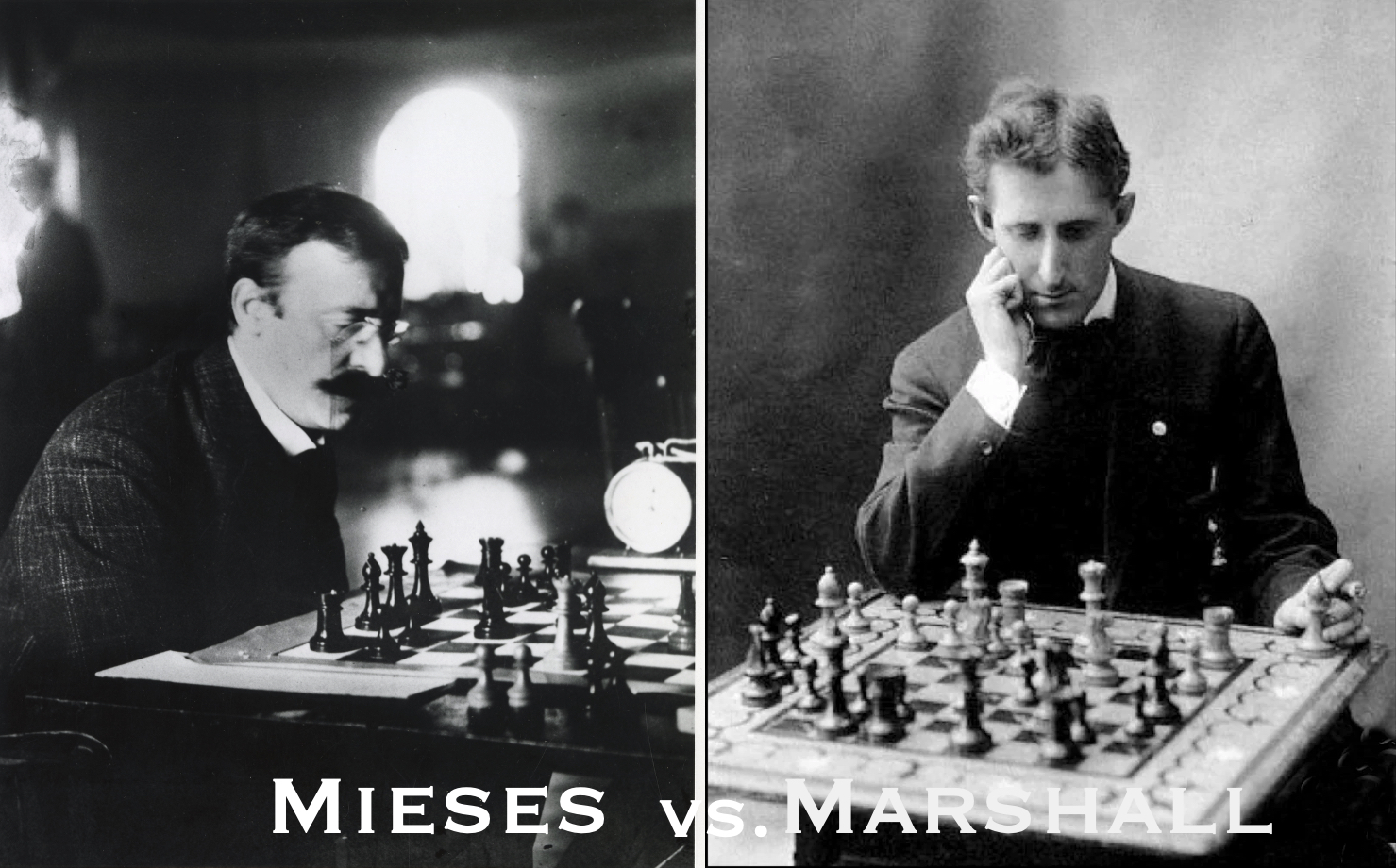
Background: Marshall’s 1908 Tour
Frank Marshall arrived in Berlin in the autumn of 1908 after a gruelling stretch of competitive chess. In August he had won the 16th Congress of the German Chess Federation in Düsseldorf. In September he played a four-man tournament in Lodz alongside Rubinstein, Salwe and Tartakower; Rubinstein and Salwe shared first place, Marshall finished third.
In October and November Marshall contested a match against Akiba Rubinstein in Warsaw and lost narrowly, 3½–4½. He arrived in Berlin not as a victor but as a beaten man. In a letter dated 1 December 1908 to the editors of the American Chess Bulletin in New York, he wrote: “I am quite tired out, and think I have had too much chess of late.”
Sources: Donaldson/Minev, The Life and Games of Akiba Rubinstein, Vol. 1; American Chess Bulletin, Vol. 6, January 1909, p. 13.
Format and Conditions
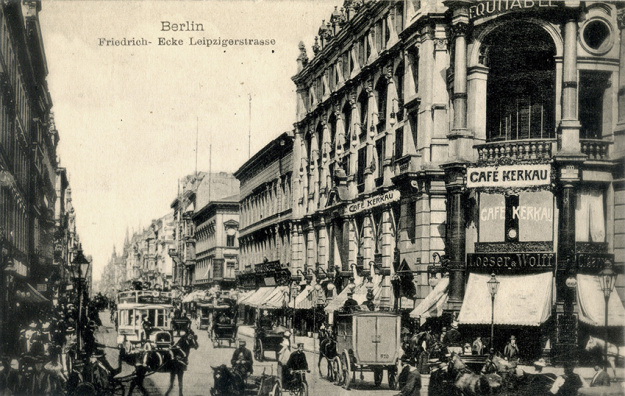
The match was played at the Café Kerkau, Friedrichstrasse 59–60, corner of Leipziger Strasse, in the so-called Equitable-Palast. Hugo Kerkau, a former Berlin billiards champion, had opened the establishment around 1900. It was one of Berlin’s principal chess venues before 1914; the Berlin Chess Society had been based there since 1901. The match was scheduled for ten games over four weeks in November and December 1908. The format was a fixed number of games, not first to a set number of wins.
According to Marshall’s own account in his letter to the American Chess Bulletin, the match drew an average of over one hundred spectators per playing day. Annotations were provided by two chess journalists: Leopold Hoffer for the American Chess Bulletin in New York (eight of the ten games), and the Brooklyn Daily Eagle for the final two games.
Course of the Match
| Game | White | Opening | Result |
|---|---|---|---|
| 1 | Marshall | Queen’s Gambit Declined | 1–0 Marshall |
| 2 | Mieses | Vienna Game | 1–0 Mieses |
| 3 | Marshall | Queen’s Gambit Declined | ½–½ |
| 4 | Mieses | Vienna Game | 1–0 Mieses |
| 5 | Marshall | Queen’s Gambit Declined | 1–0 Mieses |
| 6 | Mieses | Vienna Game | 1–0 Mieses |
| 7 | Marshall | Queen’s Gambit Declined | 1–0 Marshall |
| 8 | Mieses | Vienna Game | 1–0 Mieses |
| 9 | Marshall | Queen’s Gambit Declined | 1–0 Marshall |
| 10 | Marshall | Vienna Game | 1–0 Marshall |
| Final Score | Marshall 5½, Mieses 4½ (+5 −4 =1) | ||
The Finest Game of the Series
Leopold Hoffer, who annotated the match games for the American Chess Bulletin in New York, considered the eighth game the finest of the entire series. Mieses played White with his Vienna Opening, built a superior centre, launched a direct attack on the king and decided the game with a calculated exchange sacrifice. The win put him ahead 4½–3½ after eight games.
“This, the eighth game of the series, is considered there to be the finest of the series.”
Game 8: Mieses vs Marshall
With his kingside attack in the eighth game, Mieses secured his match lead.
Game details and notation
| White | Mieses, Jacques |
|---|---|
| Black | Marshall, Frank James |
| Event | Match Marshall-Mieses, Berlin GER |
| Date | 30 November 1908 |
| Round | 8 |
| Opening | Vienna Game, Anderssen Defense (ECO C25) |
| Result | 1–0 |
1. e4 e5 2. Nc3 Bc5 3. g3 Nc6 4. Bg2 h5 5. h3 h4 6. g4 d6 7. Na4 Be6 8. d3 g5 9. c3 a6 10. Nf3 f6 11. d4 exd4 12. cxd4 Bb4+ 13. Nc3 Bc4 14. Qc2 Qe7 15. Bd2 O-O-O 16. b3 Bxc3 17. Bxc3 Bf7 18. O-O Bg6 19. Nd2 d5 20. Rfe1 Qd7 21. Qb2 Nge7 22. b4 dxe4 23. Nxe4 Bxe4 24. Bxe4 Qd6 25. b5 axb5 26. Qxb5 Nd5 27. Rab1 Nb6 28. d5 Na7 29. Qa5 Kb8 30. Bd4 Nac8 31. Bc5 Qd7 32. d6 Nxd6 33. Rxb6 33... cxb6 34. Bxb6 Nc8 35. Bf5 Qd6 36. Bxc8 Kxc8 37. Rc1+ Kd7 38. Qf5+ Ke8 39. Qg6+ 1-0
Notation in English algebraic form, as in the viewer.
Marshall’s Comeback
After Hoffer’s favourite game, Mieses led 4½–3½. Marshall needed more than half a point from the remaining two games to turn the match around. He won both. In the ninth game (Marshall with White, Queen’s Gambit Declined) he developed his king’s bishop via g2, which the Brooklyn Daily Eagle described as “the new Russian wrinkle,” sacrificed the exchange on move 23 and won against what the newspaper called an “utterly routed” Mieses.
In the final game Marshall had White and played the Vienna Game. Marshall exchanged queens on move 15, won a weak pawn and launched an attack in which he had three pieces en prise simultaneously. A daring calculation that worked only because Marshall saw several half-moves further. The Brooklyn Daily Eagle called the finish “a very pretty mating net.” The match was decided.
Source: Brooklyn Daily Eagle, 21 December 1908, p. 22.
Game 9: Marshall’s “Russian Wrinkle”
Marshall developed his king’s bishop via g2 and sacrificed the exchange to level the match.
Game details and notation
| White | Marshall, Frank James |
|---|---|
| Black | Mieses, Jacques |
| Event | Match Marshall-Mieses, Berlin GER |
| Date | 1 December 1908 |
| Round | 9 |
| Opening | Queen's Gambit Declined, Tarrasch Defense (ECO D33) |
| Result | 1–0 |
1. d4 d5 2. c4 e6 3. Nc3 c5 4. cxd5 exd5 5. Nf3 Nc6 6. g3 Be6 7. Bg2 Nf6 8. Bg5 Be7 9. dxc5 Qa5 10. O-O Qxc5 11. Rc1 Rd8 12. Na4 Qa5 13. Nd4 Nxd4 14. Qxd4 O-O 15. Nc5 Qxa2 16. Nxe6 fxe6 17. Rc7 Rf7 18. Bh3 Qa6 19. Rfc1 Qxe2 20. Be3 Rd6 21. Qe5 Qa6 22. Bc5 Nd7 23. Rxd7 Rxd7 24. Bxe6 Qc6 25. Be3 Qd6 26. Rc8+ Bd8 27. Bxf7+ Kxf7 28. Qf5+ Bf6 29. Bc5 g6 30. Qh3 1-0
Notation in English algebraic form, as in the viewer.
Game 10: The Mating Net
Marshall played the Vienna Game with White and calculated a mating finale with three pieces en prise.
Game details and notation
| White | Marshall, Frank James |
|---|---|
| Black | Mieses, Jacques |
| Event | Match Marshall-Mieses, Berlin GER |
| Date | December 1908 |
| Round | 10 |
| Opening | ECO C26 |
| Result | 1–0 |
1. e4 e5 2. Nc3 Nf6 3. g3 Nc6 4. Bg2 Bc5 5. d3 d6 6. Na4 Bg4 7. f3 Be6 8. Ne2 Qd7 9. h3 Nd4 10. Nxc5 dxc5 11. Nxd4 Qxd4 12. f4 c4 13. f5 Bd7 14. Qe2 cxd3 15. Qxd3 Qxd3 16. cxd3 Bb5 17. d4 exd4 18. e5 Nd7 19. a4 Ba6 20. b4 c6 21. Bf4 O-O 22. O-O-O d3 23. Rhe1 Nb6 24. a5 Na4 25. Kd2 Nb2 26. Ra1 Rad8 27. Kc3 d2 28. Bxd2 Rd3+ 29. Kc2 Rxg3 30. Rg1 Nc4 31. Bf4 Ne3+ 32. Kb3 Bc4+ 33. Kc3 Nd1+ 34. Kd4 Rd8+ 35. Kc5 Rc3 36. Rc1 Bb5+ 37. Rxc3 Nxc3 38. Ra1 Nd5 39. Bg3 Nc7 0-1
Notation in English algebraic form, as in the viewer.
Tarrasch’s Verdict
Eight years later, in the preface to his match book on his own 1916 contest against Mieses, Siegbert Tarrasch drew an ironic balance. Tarrasch counted match scores without draws, which is why he gave Marshall’s 5½–4½ as 5–4. Marshall had won “mit 5:4” (“by 5 to 4”), Tarrasch wrote, adding: “wenn man dies noch einen Sieg nennen kann” (“if one can still call this a victory”).
Tarrasch, Schachwettkampf, preface, p. 4.
Just six weeks after the Berlin match ended, Mieses was already at the board for his next contest. In January 1909 he faced Carl Schlechter in Stuttgart in the first blindfold match between two internationally recognized masters, and won two and a half to half.
Sources
- American Chess Bulletin, Vol. 6, January 1909, pp. 13–17. Marshall’s letter of 1 December 1908. Annotations by Leopold Hoffer for eight of the ten games.
- Brooklyn Daily Eagle, 21 December 1908, p. 22. Report on the final two games.
- Donaldson/Minev, The Life and Games of Akiba Rubinstein, Vol. 1. Table: Warsaw, October–November 1908.
- Tarrasch, Der Schachwettkampf Tarrasch–Mieses im Herbst 1916, Veit & Comp., Leipzig 1916. Preface, p. 4.
From the Forthcoming Biography
The Marshall–Mieses match of 1908 will be covered in full in the Mieses biography by Johannes Geppert (coming spring 2027 from Hentrich & Hentrich Verlag Berlin Leipzig). All ten games with complete annotations, press reports and previously unpublished sources.
More about the biography & newsletter