The Menchik–Mieses Match
London, 21 May to 13 June 1942
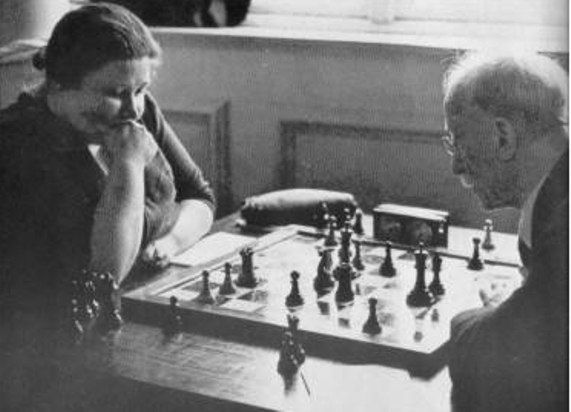
Mieses's Announcement: “Ladies at the Chess Board”
Six days before the match began, on Friday, 15 May 1942, Mieses devoted his chess column in the London exile paper Die Zeitung to an unusual preview. Readers used to seeing endgame studies and chess problems were offered instead a short cultural history of women in chess. Mieses traced it from two famous literary chess scenes: one in Lessing's play Nathan the Wise in which the Sultan Saladin is defeated by his sister Sittah; the other in Goethe's drama Götz von Berlichingen in which the Bishop of Bamberg loses to the lady Adelheid. From there he moved through the great age of medieval European chess, the rupture of the Thirty Years' War, the founding of London's Ladies Chess Club in 1895, and the inaugural Women's World Championship of 1927, won by the not-quite-22-year-old Vera Menchik and held by her ever since.
In the second half of his preview Mieses turned to his opponent and to himself. Among her own sex, Menchik stood in “a class of her own”; she had “held her own” even against masters. He then announced his terms: „Diese Veranstaltung darf in doppelter Hinsicht als ein Unikum in der Geschichte des Schachspiels hervorgehoben werden. Niemals bisher hat eine Frau einen ernsten Wettkampf gegen einen Meister der internationalen Klasse ausgefochten. Noch niemals ist es einem Spieler meines Alters – ich bin 77 Jahre alt – unternommen, in der Schacharena zu stehen.“ (This event may be highlighted as a twofold first in the history of chess. Never before has a woman fought a serious match against a master of the international class. Never before has a player of my age, I am 77 years old, taken on the task of standing in the chess arena.) He would have to play his best, he concluded, in order not to “share the fate of Sultan Saladin and the Bishop of Bamberg.” The venue was given as a building of the John Lewis company at 31 Cavendish Square, in London's West End, and the start date as Thursday, 21 May 1942.
Background: Two Worlds, One Board
When the two players met in London in May 1942, forty-one years separated them. Mieses, born in Leipzig in 1865, had fled to England after the November 1938 pogrom; an entire German life now lay behind him. Vera Menchik, born in Moscow in 1906 to a Czech father and an English mother, had held the Women's World Championship without interruption since 1927, with successful title defences in 1930, 1931, 1933, 1935, 1937 and 1939, never once defeated.
The story of her rise was at the same time the story of male chess discomfort with a serious female rival. In 1929, in Carlsbad, before her first appearance in a strong men's grandmaster tournament, the Viennese master Albert Becker proposed the ironically named “Menchik Club”: any master who lost to her would automatically be enrolled. The first member was, promptly and involuntarily, Becker himself. The membership list grew considerably in the following years – Max Euwe, Mir Sultan Khan and Samuel Reshevsky among them. The mocking signboard turned, over time, into a quiet badge of honour.
Significance: The First Serious Match Between a Woman and a Grandmaster
Robert B. Tanner, Menchik's biographer, has placed the match in a single sentence: it was “the first ever serious match between a woman and a strong master.” Women and grandmasters had certainly faced each other in tournaments before 1942 – with Menchik herself leading the way since 1929 – but a dedicated head-to-head encounter over multiple games, played at serious time controls and under the eyes of the chess public, had never taken place.
That this historic match came about at all was a product of the particular circumstances of the London exile. Jacques Mieses, once a Berlin salon master and Vienna Trebitsch champion, had become – after professional ban, flight and internment – the figurehead of a small community of German-speaking émigrés. Vera Menchik lived with her mother and her sister Olga in Clapham, in south London, and continued to work as a chess professional under wartime conditions. London in 1942 was a city under bombardment, in which the very idea of a four-week master match expressed both defiance and a quiet matter-of-factness.
Course of the Match
Ten games were played between Thursday, 21 May, and Saturday, 13 June 1942. Mieses reported on the course of the match for six successive Fridays in his chess column, sometimes with results only, sometimes with full notation. The first game stretched over nearly eight hours on opening day and ended in a win for Menchik. Eight of the ten games are preserved in full or partial notation on BritBase, drawn mainly from the contemporary reports in the *British Chess Magazine* and the magazine *CHESS*. Mieses's only win came in the sixth game, a long French Exchange that ran to seventy-four moves. As White he played the French in all four of his openings; as Black he answered Menchik's queen's pawn three times with the same flexible setup. The seventh game on 5 June ended in a draw after thirty-five moves of perpetual check; the full notation Mieses published a week later, with his own annotations, in *Die Zeitung*. The match ended on Saturday, 13 June 1942, with the score 6½ to 3½ in Menchik's favour.
| Game | Date | White | Opening | Result | Notation |
|---|---|---|---|---|---|
| 1 | 21. Mai 1942 | Menchik | 1.d4 d6 (B00) | 1:0 Menchik, nearly eight hours game | 15 moves |
| 2 | Ende Mai 1942 | 0:1 Menchik (BritBase), Remis (according to Mieses), see notes | no notation available | ||
| 3 | 28. Mai 1942 | Menchik | King's Gambit Declined (C30) | Remis after 50 moves | full |
| 4 | 29. Mai 1942 | Mieses | French Exchange (C01) | 0:1 Menchik after 23 moves | full |
| 5 | 1. Juni 1942 | Menchik | Queen's Pawn Game (A41) | 1:0 Menchik after 47 moves | full |
| 6 | 3. Juni 1942 | Mieses | French Exchange (C01) | 1:0 Mieses after 74 moves, only Mieses win | full |
| 7 | 5. Juni 1942 | Menchik | Queen's Pawn Game (A41) | Remis | with Mieses's annotations |
| 8 | Juni 1942 | French Exchange (C01) | Remis | opening only | |
| 9 | 11. Juni 1942 | Menchik | Queen's Pawn Game (A41) | Remis after 48 moves | full |
| 10 | 13. Juni 1942 | Mieses | French Exchange (C01) | Remis | opening only |
| Endstand | Menchik 6½ : Mieses 3½ (+4 =5 −1 für Menchik) | ||||
A note on the source situation: the table follows the BritBase record, which collects the notations as they appeared in the contemporary chess magazines (*British Chess Magazine*, *CHESS*, with occasional references to the *Belfast News-Letter* and the *Australasian Chess Review*). Two discrepancies with Mieses's own reports in the London *Zeitung* should be noted. First, Mieses's column of 29 May 1942 describes the second game as a draw, whereas BritBase records it as a Menchik win without surviving notation. Both versions are compatible with the documented final score; whether Mieses or the secondary sources are mistaken cannot be decided in retrospect. Second, in the closing summary of 26 June 1942 Mieses calls the seventh game a Mieses win, which contradicts both the full notation of that game (drawn by perpetual check) and his own column of 12 June ("the seventh ended in a draw"). Mieses most likely lost count by one position in the closing column. The final score itself is unaffected by either inconsistency.
Illness and Interruption
In the course of the second week, the match had to be suspended for several days. In his column of 19 June 1942, Mieses noted soberly that “a multi-day interruption became necessary, as Mieses was suffering from a persistent physical indisposition.” What lay behind that careful formula he only made explicit years later, in a private letter to his old friend Adolf Seitz. The original was in English, written in London in 1945, and reads:
“Yes, I played a match with Vera Menchik and, no wonder, I lost it, since I got seriously ill during the match, suffering of a very painful Blasenleiden. The match had to be interrupted for about a week but that was not sufficient for curing me and Vera Menchik could not agree to a longer postponement because she was engaged by the Government for war work.”
This single sentence captures the central condition of the second half of the match: the bladder complaint (Blasenleiden) for which a week's pause proved insufficient; and Menchik's wartime commitments, which ruled out any longer postponement. Mieses played out the closing games while still unwell.
An Annotated Game
The seventh game is the only one of the match to have come down to us with Mieses's own annotations. It was played on Friday, 5 June 1942. Menchik opened, as in all her white games, with the queen's pawn. Mieses replied with a flexible setup that allowed the swift advance of the king's pawn. The game ran for thirty-five moves into an endgame in which Black, thanks to a precise queen manoeuvre (22…Qa4!), even gained counterchances. The finish by perpetual check is exemplary.
Seventh Game: Queen's Pawn Opening, London, 5 June 1942
Menchik – Mieses, drawn after 35 moves. The notation and the italicised annotations are taken from Mieses's own chess column in Die Zeitung (London) of 19 June 1942.
Game details and notation
| White | Menchik, Vera |
|---|---|
| Black | Mieses, Jacques |
| Event | Wettkampf Menchik-Mieses, London |
| Date | 5 June 1942 |
| Opening | Damenbauernspiel (ECO A41) |
| Result | ½–½ |
1. d4 1... d6 2. Nf3 Nc6 3. Bf4 g6 4. h3 4... Bg7 5. e4 Nxd4 6. Nxd4 e5 7. Be3 exd4 8. Bxd4 Nf6 9. Nc3 O-O 10. Qf3 Bd7 11. O-O-O! Re8 12. Bc4 Bc6 13. Rhe1 Qe7 14. g4 14... Bh6+! 15. Be3 15... Bxe3+ 16. Rxe3 Kg7! 17. Rde1 Nd7 18. Qg3 Ne5 19. Bd5 g5 20. Ne2 Bxd5 21. exd5 Qd7! 22. Nd4 Qa4! 23. Nf5+ Kf8 24. a3 Qa5 25. Qg2! 25... Nc4 26. Rxe8+ Rxe8 27. Rxe8+ Kxe8 28. Qe4+ Ne5 29. c3 Qb5 30. Kc2 Qf1 31. Qe3 Qc4 32. Qxg5 Qd3+ 33. Kb3 Qxd5+ 34. Kc2 Qd3+ 35. Kb3 Qd5+ 1/2-1/2
Notation in English algebraic form, as in the viewer.
Mieses's Public Tribute
Mieses's first detailed assessment of the match appeared in his chess column „Schach. Bearbeitet von J. Mieses“ in the London exile paper Die Zeitung on 26 June 1942. Die Zeitung was the central German-language newspaper of the British exile community during the Second World War; Mieses had taken over its weekly chess page in 1941. His balance of the match is the most direct source we have, and it is striking how openly he attributes the outcome to his own circumstances rather than to any deficiency in his game.
On the level of preparation, he wrote: „Bei Beginn des Kampfes waren beide Spieler erheblich ausser Übung, wie auch aus der Qualität der Partien hervorgeht. Sie haben ja, des Krieges wegen, mehrere Jahre keine Gelegenheit zu ernsten Meisterpartien gehabt.“ (At the beginning of the contest both players were considerably out of practice, as is also evident from the quality of the games. Owing to the war, they had had no opportunity for serious master play for several years.)
On the asymmetry of the lay-off, he was equally candid: „Dieser lange Mangel an Training hat sich begreiflicherweise bei Mieses stärker geltend gemacht, als bei seiner mehr als 40 Jahre jüngeren Gegnerin.“ (This long lack of training naturally affected Mieses more than it did his more than forty years younger opponent.)
And on his health during the match: „Er hat ausserdem während einiger Partien unter einer sehr störenden körperlichen Indisposition gelitten.“ (He also, during several games, suffered under a very disruptive physical indisposition.)
Mieses reserved the closing words of his column for his opponent, without reservation:
„Vera Menchik hat ihren bisherigen guten Leistungen in internationalen Meisterturnieren nunmehr einen beachtenswerten Sieg in einem schweren Einzelwettkampf hinzugefügt. Sie dürfte jetzt erst zur vollen Entwicklung ihrer Spielstärke gelangt sein.“
That last sentence carries a particular weight in retrospect. Mieses, a veteran of classical match chess, described his 36-year-old conqueror not as already established but as a player only now reaching her full powers – someone whose actual career still lay ahead. Two years later, Menchik was dead.
The Tragic Aftermath: 27 June 1944
On 27 June 1944, a little more than two years after the match, a German V-1 flying bomb struck 47 Gauden Road, Clapham, in south London. Vera Menchik, her mother Olga (Mrs Rubery) and her sister Olga Menchik all died in the explosion. Vera Menchik was thirty-eight.
The Women's World Championship, which she had held without interruption for seventeen years, then remained vacant for six years. It was only in 1950 that the Soviet master Lyudmila Rudenko was determined as her successor.
Mieses's own life was touched by the same V-1 campaign. Later that summer of 1944 his flat in Edith Road, Kensington, was so badly damaged in an attack that he had to be evacuated. By any reasonable expectation he would have been the one to predecease Menchik; in the event the order was the reverse.
Sources
- Robert B. Tanner, Vera Menchik: A Biography. Tanner there describes the match as “the first ever serious match between a woman and a strong master” (cited after Edward Winter, Chess Notes C.N. 10191).
- Die Zeitung (London), weekly chess column „Schach. Bearbeitet von J. Mieses.“ Six issues between May and June 1942, page 9 in each: Friday, 15 May 1942 (preview „Damen am Schachbrett“ with venue announcement); 29 May 1942 (games 1 and 2); 5 June 1942 (games 3 and 4); 12 June 1942 (games 5 to 7, with photograph of Menchik and Mieses at the board); 19 June 1942 (annotated notation of the seventh game); 26 June 1942 (closing summary with public tribute to Menchik). Holdings: German Exile Archive 1933–1945 of the German National Library, Frankfurt, assembled for the Mieses biography project by Johannes Geppert, May 2026.
- Letter from Jacques Mieses to Adolf Seitz
- Edward Winter, Chess Notes C.N. 11981, with the documentary record of Vera Menchik's death by V-1 on 27 June 1944.
- British Chess Magazine, August and September 1942; CHESS (Sutton Coldfield), July/August 1942; Belfast News-Letter, 19 August 1942; The Australasian Chess Review, 15 November 1942. Notations of games 1, 3, 4, 5, 6, 7, 9 and the opening moves of games 8 and 10. Collected on BritBase (John Saunders), www.saund.co.uk/britbase/pgn/menchik-viewer.html.
Editorial note
With the six Mieses columns from Die Zeitung and the games collected on BritBase from BCM and CHESS, the course of the match is now largely reconstructed. Eight of the ten games survive in full or partial notation and can be played through game by game in the Lichess study. For the discrepancy about game 2 and the counting error in the closing summary, see the note below the table.
From the Upcoming Biography
The Menchik–Mieses match of 1942 is treated in its full biographical context in Jacques Mieses. Sieben Jahrzehnte in der Schacharena (coming spring 2027 from Hentrich & Hentrich Verlag Berlin Leipzig). The book version contains the full analysis of all six Mieses columns from the London exile paper Die Zeitung, including Mieses's literary-historical self-positioning in the preview of 15 May 1942, the correspondence with Adolf Seitz, and the wider context of the first serious encounters between women and grandmasters in the twentieth century. An English-language edition is in preparation.
More about the biography & newsletterResearch note
The materials from the London exile paper Die Zeitung presented here were assembled between March and May 2026 for the Mieses biography project by Johannes Geppert.
When citing this page or individual sources from it, please use: Johannes Geppert, mieses.info, accessed [date], ORCID 0009-0004-6545-3067.