Blindfold Match Schlechter–Mieses
Stuttgart, 13–15 January 1909
Mieses' Preview Article: At Night the Imagination Works
On the eve of the match, 12 January 1909, the Stuttgarter Neues Tagblatt printed an article by Mieses under the title “Das Blindlingsspiel beim Schach” (Blindfold Play in Chess). He defined the chief requirement not as memory but as a vivid power of spatial imagination. The player must see the image of each position “so vividly in his mind’s eye, as if the board stood in front of him” (“das Bild der jeweiligen Stellung so lebhaft vor seinem inneren Auge sehen, als ob das Brett vor ihm stünde”).
One observation in the article was particularly striking. Mieses had noticed that he found blindfold play harder during the day than at night. “I explain this by the fact that the imagination, which is called upon more strongly in blindfold play than in ordinary play, works most vividly at night” (“Ich erkläre mir dies damit, dass die Phantasie, die ja beim Blindspiel stärker als beim gewöhnlichen Spiel in Anspruch genommen wird, nachts am lebhaftesten arbeitet”). Play in Stuttgart was scheduled from eight to twelve in the evening, “a time of day well suited to blindfold chess” (“also zu einer für das Blindspiel geeigneten Tageszeit”).
Source: Stuttgarter Neues Tagblatt No. 8, 12 January 1909. Facsimile in Martin Ramsauer, Schach in Württemberg vol. 1, Marbach 2013.
Format and Conditions
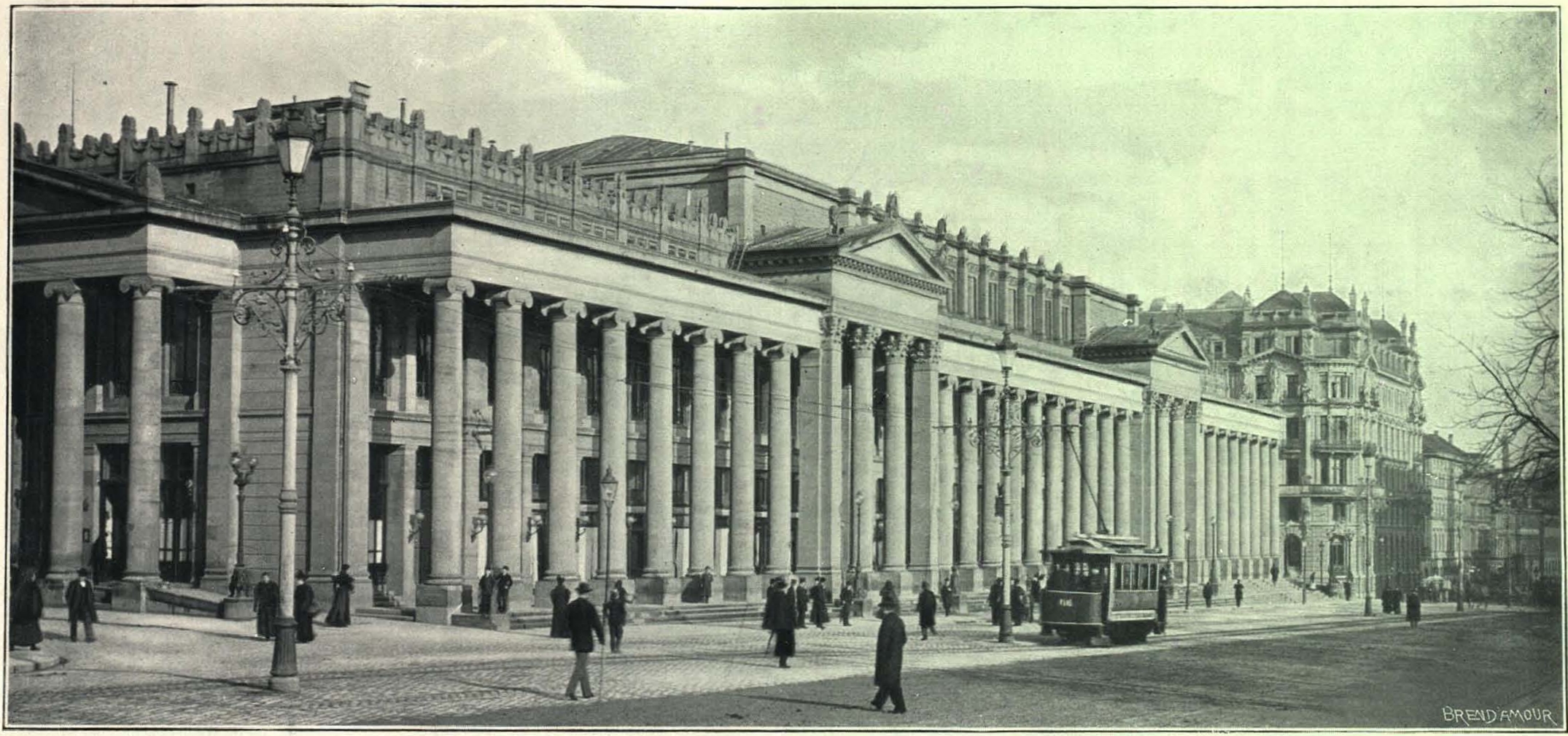
The venue was the Vorsaal (anteroom) of the Königsbau in Stuttgart, Königstraße 26 on the Schloßplatz. Three games on three consecutive evenings from 13 to 15 January 1909, each from 8 pm to midnight. Time control: fifteen moves per hour. Admission: fifty pfennigs for a single evening, one mark for a season ticket. The chair was taken by Otto Rosenfeld, president of the Stuttgart Chess Club.
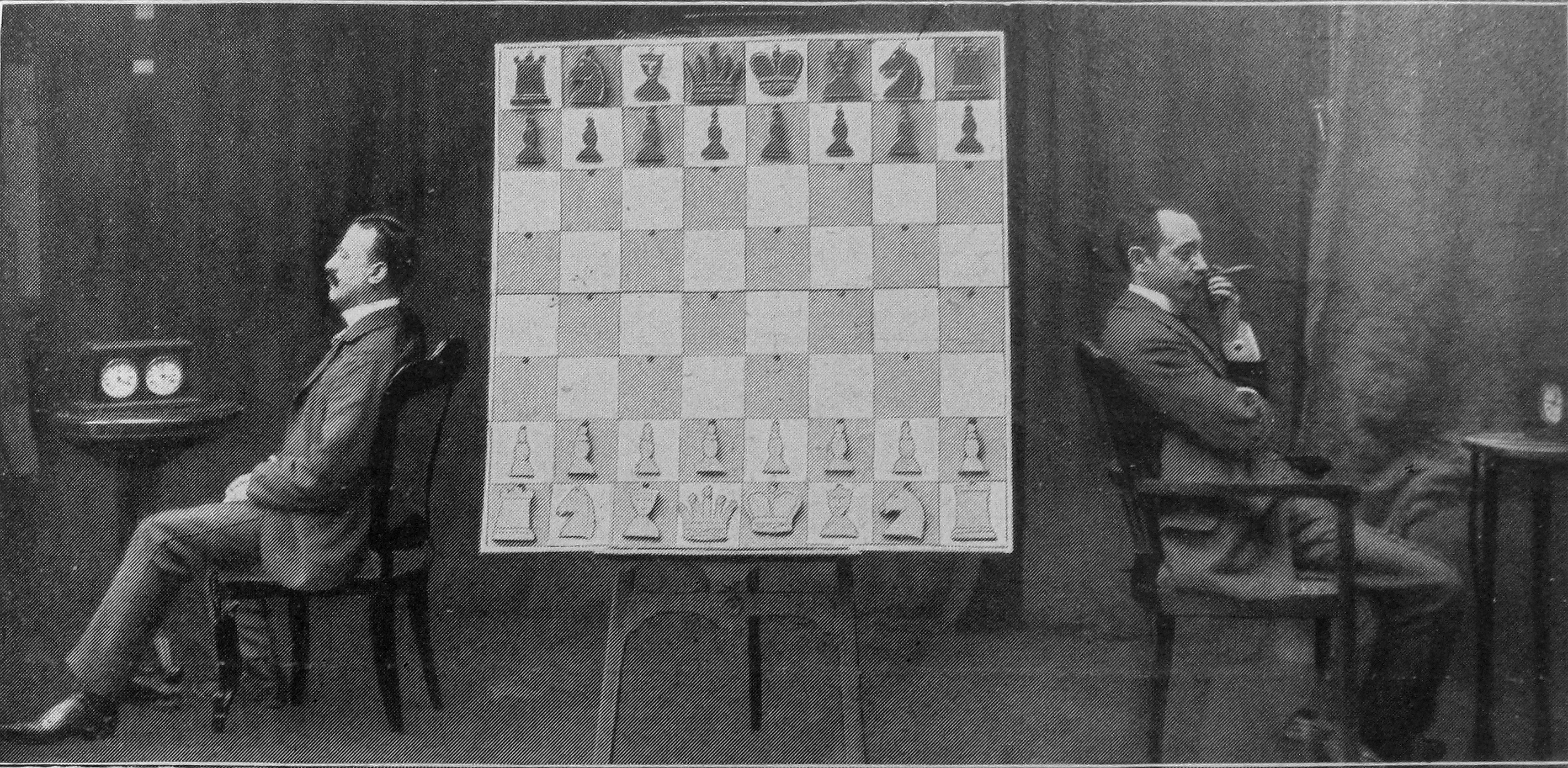
The two masters sat at separate tables, without a chessboard. Their moves were dictated to an intermediary and displayed on a large demonstration board. At the neighbouring tables, chess enthusiasts followed the play on their own boards. Contemporary annotations were provided by two chess journalists: Schlechter himself for the Deutsche Schachzeitung, of which he was co-editor alongside Johann Berger at the time, and Leopold Hoffer for The Field in London.
Course of the Match
| Game | Date | White | Opening | Result | Annotator |
|---|---|---|---|---|---|
| 1 | 13 Jan 1909 | Schlechter | Scandinavian | 0–1 Mieses | DSZ, The Field |
| 2 | 14 Jan 1909 | Mieses | Göring Gambit | ½–½ | DSZ, The Field |
| 3 | 15 Jan 1909 | Schlechter | Scandinavian | 0–1 Mieses | DSZ |
| Final score | Mieses 2½, Schlechter ½ (+2 =1 −0) | ||||
First Game: The ABC Mate
Otto Rosenfeld, president of the Stuttgart Chess Club, welcomed the audience and gave a brief overview of the development of chess. He then proceeded to draw lots for colours. Schlechter received White and opened with the king’s pawn. Mieses replied with his Scandinavian. Four hours later Schlechter resigned. What the Wiener Schachzeitung later called the “ABC mate” occurred on move 28: Schlechter retreated the wrong rook and allowed Black an elementary queen mate on the back rank.
“ABC-Matt”
First Game: Schlechter vs Mieses
Scandinavian Defence with Hoffer annotations from The Field and Schlechter annotations from the DSZ.
Game details and notation
| White | Carl Schlechter |
|---|---|
| Black | Jacques Mieses |
| Event | Blindschach-Wettkampf Schlechter-Mieses, Stuttgart GER |
| Date | 13 January 1909 |
| Round | 1 |
| Opening | ECO B01 |
| Result | 0–1 |
| Source | Stuttgarter Neues Tagblatt Nr. 10, 14. Januar 1909; Notation in DSZ 1909 Januar-Heft, S. 16, Annotationen in DSZ 1909 Februar-Heft, S. 48 f. Hoffer in The Field 1909. |
1.e4 d5 2.exd5 Qxd5 3.Nc3 Qa5 4.Bc4 Nf6 5.d4 Nc6 6.Nge2 Bf5 7.Bd2 Qb4 8.b3 e5 9.Nb5 Qe7 10.d5 Nd4 11.d6 cxd6 12.Nbxd4 exd4 13.O-O d5 14.Bb5+ Bd7 15.Nxd4 O-O-O 16.Bf4 Ne4 17.Re1 Bxb5 18.Nxb5 Qc5 19.Nd4 Bd6 20.Bxd6 Rxd6 21.Qg4+ Rd7 22.Qxg7 Re8 23.Rad1 f5 24.Qh6 Rde7 25.Re3 Nc3 26.Rde1 Qxd4 27.Rxe7 Ne2+ 28.R7xe2 Rxe2 29.Rxe2 Qd1+ 0-1
Notation in English algebraic form, as in the viewer.
Second Game: Pawn Sacrifice and Bishops of Opposite Colour
On Thursday 14 January, Mieses opened with 1.e4 e5 and Schlechter replied with the classical king’s knight deployment. Mieses chose the Göring Gambit, that rare variation of the Scotch Game in which White sacrifices a second pawn for rapid development. Schlechter accepted, returned a pawn and steered into an endgame with bishops of opposite colour in which a pawn advantage for Black was insufficient to win.
After thirty-nine moves the position was drawn. It was the only game of the match in which neither master could extract a clear advantage. Schlechter later annotated the endgame in the Deutsche Schachzeitung with a notably lengthy complex of variations, into which the Polish master Dawid Przepiórka also contributed.
Source: Annotations by Schlechter (DSZ 1909, February issue, pp. 48 f.) and Hoffer (The Field 1909). Score from DSZ 1909, January issue, p. 17.
Second Game: Mieses vs Schlechter
Göring Gambit with Schlechter annotations from the DSZ and Hoffer annotations from The Field.
Game details and notation
| White | Jacques Mieses |
|---|---|
| Black | Carl Schlechter |
| Event | Blindschach-Wettkampf Schlechter-Mieses, Stuttgart GER |
| Date | 14 January 1909 |
| Round | 2 |
| Opening | ECO C44 |
| Result | ½–½ |
| Source | Stuttgarter Tagespresse 14.-15. Januar 1909; Notation in DSZ 1909 Januar-Heft, S. 17, Annotationen in DSZ 1909 Februar-Heft, S. 48 f. Hoffer in The Field 1909. |
1.e4 e5 2.d4 exd4 3.c3 dxc3 4.Bc4 Nf6 5.Nxc3 Nc6 6.Nf3 Bb4 7.O-O O-O 8.e5 Bxc3 9.bxc3 d5 10.exf6 dxc4 11.fxg7 Kxg7 12.Nd4 Nxd4 13.cxd4 Re8 14.d5 Qf6 15.Be3 Qg6 16.Rc1 Bh3 17.Qf3 Bg4 18.Qg3 Be2 19.Rfe1 Qxg3 20.hxg3 Bd3 21.Bf4 Rxe1+ 22.Rxe1 Rd8 23.Re7 Rxd5 24.Rxc7 Ra5 25.Rxb7 Rxa2 26.g4 Kf6 27.Be3 a5 28.f4 Rxg2+ 29.Kxg2 Be4+ 30.Kf2 Bxb7 31.Bd4+ Ke6 32.Ke3 f5 33.g5 Kd5 34.Bc3 a4 35.Bb4 Ba6 36.Bc3 a3 37.Bb4 a2 38.Bc3 Bb5 39.Bd4 1/2-1/2
Notation in English algebraic form, as in the viewer.
Third Game: The Queen Sacrifice
On Friday evening, 15 January, the audience was larger still than on the previous two nights. Again Schlechter played 1.e4, again Mieses replied 1...d5. On move 11 Mieses sacrificed his queen for a rook and two minor pieces. Schlechter launched a king-side attack through the centre, but Mieses had calculated more deeply. Two passed pawns on the b-file did the rest. After forty-four moves Schlechter resigned.
“This novel match was played at Stuttgart in January, and aroused the keenest interest. The quality of the games can only be described as amazing.”
Third Game: Schlechter vs Mieses
Scandinavian Defence with Schlechter annotations from the DSZ.
Game details and notation
| White | Carl Schlechter |
|---|---|
| Black | Jacques Mieses |
| Event | Blindschach-Wettkampf Schlechter-Mieses, Stuttgart GER |
| Date | 15 January 1909 |
| Round | 3 |
| Opening | ECO B01 |
| Result | 0–1 |
| Source | Stuttgarter Neues Tagblatt Nr. 12, 16. Januar 1909; Aus Leben, Kunst und Wissenschaft Nr. 16, 21. Januar 1909; Notation und Annotationen Schlechter in DSZ 1909 Februar-Heft, S. 48 f. |
1.e4 d5 2.exd5 Qxd5 3.d4 Nf6 4.Nc3 Qa5 5.Nf3 Nc6 6.Bd2 Bg4 7.Nb5 Qb6 8.a4 Bxf3 9.Qxf3 a6 10.a5 axb5 11.axb6 Rxa1+ 12.Bc1 Rxc1+ 13.Kd2 Rxc2+ 14.Kd1 Rxb2 15.Qa3 Rb1+ 16.Kc2 Rxf1 17.Qa8+ Kd7 18.Rxf1 Nd5 19.Qxb7 Nxb6 20.Kb1 e6 21.Rc1 Nc4 22.Qa8 g6 23.d5 exd5 24.Rd1 d4 25.Rxd4+ Nxd4 26.Qd5+ Bd6 27.Qxd4 Re8 28.Qd5 c6 29.Qxf7+ Re7 30.Qg8 Re1+ 31.Kc2 Re2+ 32.Kd3 Rxf2 33.Qxh7+ Kc8 34.Kc3 Be5+ 35.Kd3 Rd2+ 36.Ke4 Rd4+ 37.Kf3 b4 38.Ke2 Rd2+ 39.Kf1 b3 40.Qg8+ Kc7 41.Qf7+ Rd7 42.Qxc4 b2 43.Qb3 Rd5 44.Qc2 Rc5 0-1
Notation in English algebraic form, as in the viewer.
Tarrasch’s Verdict
A week later, Siegbert Tarrasch commented on the result in the Berliner Lokalanzeiger, calling it surprising, since “heutzutage versteht wohl jeder bessere Spieler eine Blindpartie ungefähr mit derselben Stärke durchzuführen wie eine am Brett gespielte” (nowadays any reasonably strong player can conduct a blindfold game at roughly the same level as one played over the board). In Mieses’ case, however, a specialist’s skill was at work. Otto Rosenfeld closed the event with the remark that the Stuttgart Chess Club could “ohne unbescheiden zu sein, auf die Veranstaltung dieses neuartigen Wettkampfes stolz sein” (without being immodest, be proud of having organised this novel contest).
Tarrasch in Berliner Lokalanzeiger, Unterhaltungsblatt No. 18, 22 January 1909; Rosenfeld quoted from Stuttgarter Neues Tagblatt No. 12, 16 January 1909.
An Irony of Press History
A small irony of press history: the losing player was the one who reported the match in the most important German chess journal. At the time of the Stuttgart match, Carl Schlechter was based in Vienna as co-editor of the Deutsche Schachzeitung alongside Johann Berger. The scores of the first two games appeared in the January issue on pages 16 and 17. In the February issue, Schlechter published his detailed assessment with annotations to all three games on pages 48 f., openly naming his own errors.
Sources
- Stuttgarter Neues Tagblatt, No. 8 (12 Jan 1909), No. 10 (14 Jan 1909), No. 12 (16 Jan 1909). Supplement “Aus Leben, Kunst und Wissenschaft” No. 16, 21 Jan 1909.
- Württembergische Zeitung No. 10, 14 January 1909.
- Deutsche Schachzeitung, vol. 64 (1909), January issue, p. 16 (score of game 1) and p. 17 (score of game 2); February issue, pp. 48 f. (Schlechter’s annotations to all three games).
- The Field, London 1909, annotations by Leopold Hoffer.
- Wiener Schachzeitung 1909, p. 55 (the ABC mate).
- American Chess Bulletin vol. 6, 1909, p. 112.
- The Year Book of Chess 1910, pp. 16 f.
- Berliner Lokalanzeiger, 22 January 1909 (Tarrasch).
- Jacques Mieses, Das Blindspielen, Leipzig 1918, p. 41.
- Martin Ramsauer, Der Blindschach-Wettkampf zwischen Jacques Mieses und Carl Schlechter in Stuttgart, 13.–15. Januar 1909, Schach in Württemberg vol. 1, Marbach 2013.
- Martin Ramsauer, “Neues von alten Meistern: Mieses, Lasker, Schlechter, Tarrasch und Fahrni in Stuttgart 1903–1913”, in: Festschrift Egbert Meissenburg: Schachforschungen, ed. Siegfried Schönle, Vienna 2008, pp. 574–595.
From the Forthcoming Biography
The full story of the Stuttgart match, including Mieses’ own reflections on the imagination working at night, is covered in the Mieses biography by Johannes Geppert (spring 2027 from Hentrich & Hentrich Verlag Berlin Leipzig).
More about the biography & newsletter