The Tarrasch–Mieses Match
Berlin, 9 September to 5 October 1916
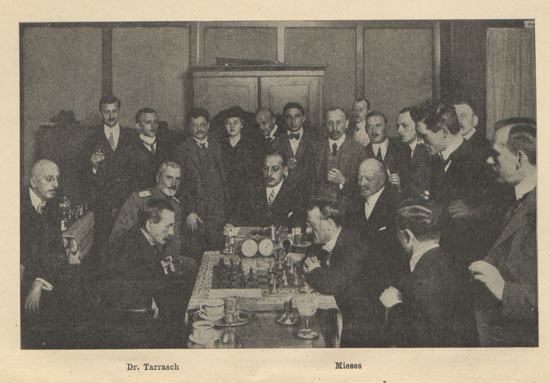
Origin: The May Games
In the spring of 1916, Tarrasch undertook a chess tour through German cities. Mieses invited him to Café Kerkau in Berlin on 14 May 1916, where they played two serious games. Mieses won the first with Black after 38 moves (French Defence against Tarrasch’s poorly chosen 3.Bd3 setup); the second was drawn.
In his newspaper columns, Mieses proclaimed victory in the “little match.” Tarrasch demanded a correction; the papers refused. Tarrasch then challenged Mieses to a proper match to “restore his wounded honour.”
Format and Conditions
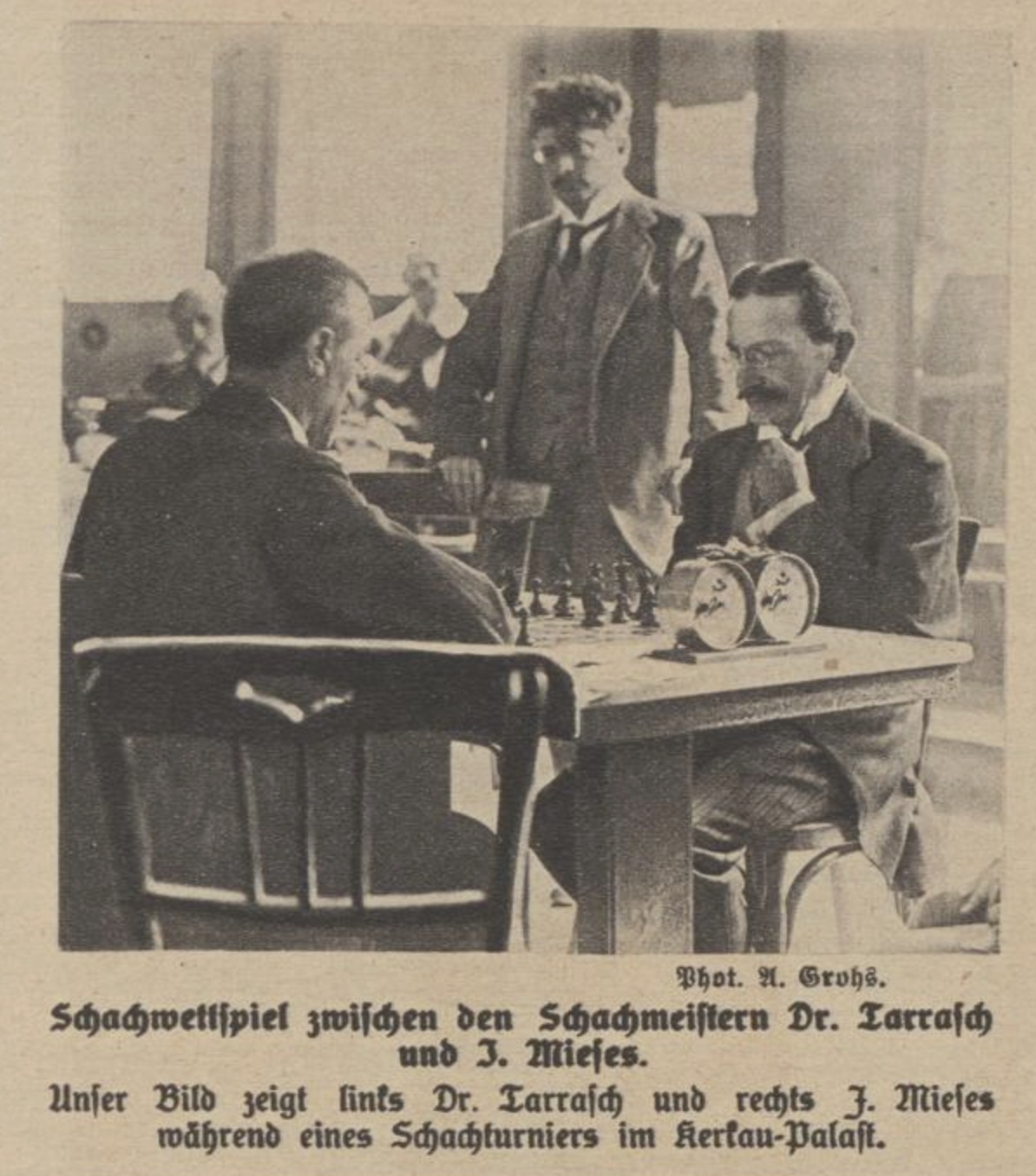
Played from 9 September to 5 October 1916 at the Kerkau-Palast, Behrenstrasse 48 in Berlin. Victory was originally set at five wins, later extended to seven. Time control: 15 moves per hour. Playing hours: weekdays 4:30 to 9:30 pm, Sundays 3:30 to 9:00 pm. Rest days: Mondays and Tuesdays, plus three optional rest days per player.
Referee: Emanuel Lasker, reigning world champion. Lasker opened the match with a speech but never had to intervene as arbiter during the entire four weeks.
Organiser: Jacques Mieses himself, with Josef König (café proprietor) as host and Bernhard Kagan (publisher) in the background. Treasurer: Paul Dyrenfurth.
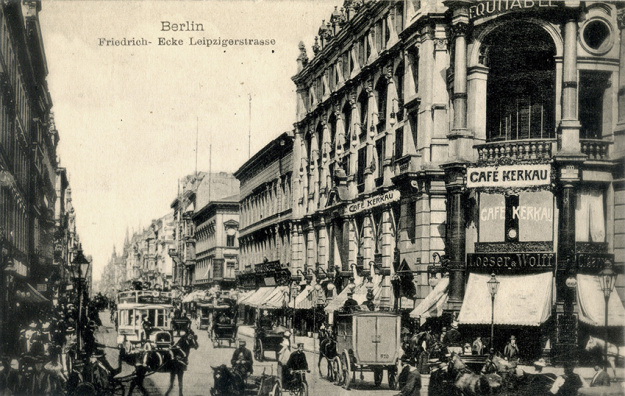
Eight years earlier, the original Café Kerkau on Friedrichstrasse had hosted the Marshall–Mieses match, also over four weeks, also before more than a hundred spectators daily.
Seven years earlier, Mieses had already proved his strength in southern Germany in another Stuttgart match, defeating Carl Schlechter two and a half to half in the first blindfold match between two internationally recognized masters.
Prizes
The German Chess Federation declined to sponsor the match; the players’ registered letter went unanswered. Three private donations materialised:
- 100 marks from Otto Rosenfeld, a Stuttgart industrialist (chairman of the Swabian Chess Federation), for the most beautiful game. Awarded to Tarrasch (game 3).
- 100 marks from Kurt Steinweg, a chess enthusiast from Cologne, for the best-played game. Awarded to Mieses (game 8).
- Half a pound of butter, donated by Fritz Neuhaus, a medical student from Herleshausen in Thuringia. By 1916, Germany was deep in the “Turnip Winter” – the Allied naval blockade had caused severe food shortages, and butter had become a near-unobtainable luxury. Given the length of the match, the players pragmatically divided the butter between them, “in the spirit of the kind donor” (Tarrasch).
The Match
| Game | Date | Colour | Moves | Opening | Result | Time |
|---|---|---|---|---|---|---|
| 1 | 9 Sept | Tarrasch | 36 | French Defence | 1–0 Tarrasch | 4½ hrs |
| 2 | 10 Sept | Mieses | 42 | Scotch Game | Draw | 4 hrs |
| 3 | 13 Sept | Tarrasch | 20 | French Defence | 1–0 Tarrasch | 2 hrs |
| 4 | 14 Sept | Mieses | 31 | Scotch Game | 0–1 Tarrasch | 4 hrs |
| 5 | 16 Sept | Tarrasch | 31 | French Defence | 1–0 Tarrasch | 3½ hrs |
| 6 | 17 Sept | Mieses | 26 | Scotch Game | Draw | 3 hrs |
| 7 | 20 Sept | Tarrasch | 32 | French Defence | Draw | 3 hrs |
| 8 | 21/22 Sept | Mieses | 57 | Scotch Game | 1–0 Mieses | 6½ hrs |
| 9 | 23/24 Sept | Tarrasch | 41 | French Defence | 1–0 Tarrasch | 5½ hrs |
| 10 | 24/27 Sept | Mieses | 37 | Scotch Game | 0–1 Tarrasch | 5 hrs |
| 11 | 28/29 Sept | Tarrasch | 56 | French Defence | Draw | 7½ hrs |
| 12 | 1/4 Oct | Mieses | 64 | Scotch Game | 1–0 Mieses | 8 hrs |
| 13 | 5 Oct | Tarrasch | 19 | French Defence | 1–0 Tarrasch | 2½ hrs |
| Final score | Tarrasch 7, Mieses 2, 4 draws | |||||
Illness and Extension
Mieses contracted a catarrh from the third to the fifth game and lost 0–3 during this phase, which Tarrasch himself described as decisive in his preface. A devoted regular spectator named Dora Hiller, whose greatest pleasure was her daily visit, suggested before the sixth game that the format be extended to seven wins.
Tarrasch later fell ill with influenza and missed “the simplest winning continuations” in the eleventh game.
Mieses’ Two Wins
Both of Mieses’ victories came with the Scotch Game (1.e4 e5 2.Nf3 Nc6 3.d4).
Game 8: Mieses Wins the Brilliancy Prize
This game was awarded the special prize of one hundred marks by a Cologne jury led by Kurt Steinweg as the “best-played game” of the match. Tarrasch considered the award questionable and noted drily in his match book that it “may have caused general head-shaking.” The annotated score is taken from that match book and contains Tarrasch’s own assessment from Black’s perspective.
Game details and notation
| White | Mieses, Jacques |
|---|---|
| Black | Tarrasch, Siegbert |
| Event | Wettkampf Tarrasch-Mieses, Berlin GER |
| Date | 21 September 1916 |
| Round | 8 |
| Opening | Schottische Partie (ECO C45) |
| Result | 1–0 |
| Source | Tarrasch, Der Schachwettkampf Tarrasch-Mieses im Herbst 1916, Veit & Comp., Leipzig 1916, S. 45-54 |
1. e4 1... e5 2. d4 exd4 3. Nf3 Nc6 4. Nxd4 Nf6 5. Nxc6 bxc6 6. e5 Qe7 7. Qe2 Nd5 8. Nd2 Bb7 9. Nb3 9... f6 10. exf6 10... Qxe2+ 11. Bxe2 Nxf6 12. O-O O-O-O 13. Na5 13... Re8 14. Bd3 Bc5 15. Nxb7 Kxb7 16. Bd2 Ne4 17. Bxe4 Rxe4 18. Rfe1 Rhe8 19. Kf1 Bd4 20. Rxe4 Rxe4 21. f3 Re6 22. c3 Bf6 23. Re1 Rxe1+ 24. Kxe1 c5 25. Ke2 d5 26. g4 Kc6 27. f4 Kd7 28. Kf3 Be7 29. f5 Ke8 30. g5 Kf7 31. h4 Ke8 32. Bf4 c6 33. Bb8 a6 34. Kf4 h6 35. Be5 hxg5+ 36. hxg5 Kf7 37. g6+ 37... Kg8 38. b3 38... Kf8 39. Ke3 Kg8 40. Kd3 Kf8 41. Kc2 Kg8 42. Kb2 Kf8 43. Kc2 Kg8 44. Kb1 Kf8 45. Kb2 Kg8 46. Ka3 Bg5 1-0
Notation in English algebraic form, as in the viewer.
Game 12: Eight Hours, a Rook Sacrifice, Influenza
According to Tarrasch’s own analysis, Black should have won this game several times over. On move 26, f7-f5 offered a decisive simplification. Tarrasch missed it and attributes this and subsequent errors openly to his influenza: “In the first five games, such oversights never occurred; but from then on, suffering from influenza and its after-effects, I tired easily.” Mieses defended the nominally lost position with the “brilliant move” 41.Qf5! for over twenty moves until winning in a pawn endgame.
Game details and notation
| White | Mieses, Jacques |
|---|---|
| Black | Tarrasch, Siegbert |
| Event | Wettkampf Tarrasch-Mieses, Berlin GER |
| Date | 1 October 1916 |
| Round | 12 |
| Opening | Schottische Partie (ECO C45) |
| Result | 1–0 |
| Source | Tarrasch, Der Schachwettkampf Tarrasch-Mieses im Herbst 1916, Veit & Comp., Leipzig 1916, S. 75-85 |
1. e4 1... e5 2. d4 exd4 3. Nf3 Nc6 4. Nxd4 Nf6 5. Nxc6 bxc6 6. Bd3 6... d5 7. exd5 7... cxd5 8. Bb5+ 8... Bd7 9. Bxd7+ Qxd7 10. O-O 10... Be7 11. Nd2 11... O-O 12. b3 Rfe8 13. Bb2 Qf5 14. Nf3 c5 15. Qd2 15... Ne4 16. Qd3 Rad8 17. Nd2 17... Bd6 18. Nxe4 dxe4 19. Qe2 Re6 20. Rfe1 Rde8 21. Rad1 Rh6 22. h3 22... Rg6 23. Qb5 Rd8 24. Qa5 Rf8 25. Qc3 Qg5 26. g3 f5 27. Qd2 Qh5 28. Qd5+ Kh8 29. Be5 29... Bxe5 30. Qxc5 Rg8 31. Qxe5 Qxh3 32. Rd6 32... Rg4 33. Rd5 33... f4 34. Qh5 Rxg3+ 35. fxg3 Qxg3+ 36. Kf1 e3 37. Ke2 37... Qf2+ 38. Kd1 f3 39. Rd3 39... e2+ 40. Kd2 Rf8 41. Qf5 41... Kg8 42. Qe6+ Kh8 43. Qf5 Kg8 44. Qe6+ Kh8 45. Qh3 45... h6 46. b4 46... Rf6 47. c4 g5 48. Qc8+ Kg7 49. Rd7+ Kg6 50. Qe8+ Kf5 51. Kd3 51... Kg4 52. Rd4+ Rf4 53. Qe6+ Kg3 54. Rxf4 Kxf4 55. Qe4+ Kg3 56. Qe5+ Kg2 57. Rxe2 fxe2 58. Qxe2 h5 59. c5 h4 60. c6 h3 61. c7 Qxe2+ 62. Kxe2 h2 63. c8=Q h1=Q 64. Qg4+ 1-0
Notation in English algebraic form, as in the viewer.
Press Coverage
The match received regular coverage in the Berlin press (Berliner Lokal-Anzeiger, Berliner Tageblatt, Vossische Zeitung, B.Z. am Mittag) and across Germany (Münchener Neueste Nachrichten, Fränkischer Kurier, Breslauer Zeitung, Frankfurter Zeitung). Internationally: Berlingske Tidende (Copenhagen), the Stockholm press, and in the United States the Washington Post and the Commercial Appeal (Memphis).
Tarrasch on Mieses’ Match Career
In the preface to his match book, Tarrasch drew an ironic yet respectful balance of Mieses’ career in matches: against Janowski and Walbrodt he drew (both “got off with a black eye”), Marshall won 5–4 (“if one can still call that a victory”), against Leonhardt and Schlechter Mieses was the winner, and against Rubinstein he won the first three games “in brilliant style” before losing “honourably” 5–3.
His conclusion: “So Mieses need not be ashamed of his failure; he finds himself in the best of company.”
Sources
- Siegbert Tarrasch, Der Schachwettkampf Tarrasch–Mieses im Herbst 1916, Veit & Comp., Leipzig 1916. 102 pages. Preface pp. 1–7. Game 8 with annotations pp. 45–54, game 12 with annotations pp. 75–85.
- Washington Post, 5 August 1917, p. 7 (game 13).
- Commercial Appeal (Memphis), 24 December 1916, p. 19 (Mieses’ winning game).
- Tidskrift för Schack 1916.
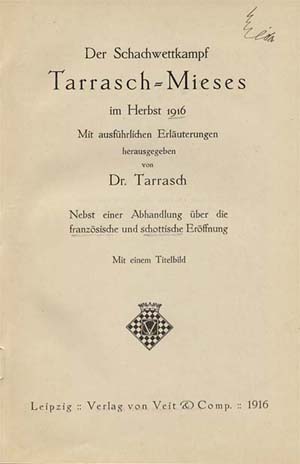
Tarrasch’s match book from 1916 – the primary source for this match.
View bookFrom the Upcoming Biography
The Tarrasch–Mieses match of 1916 will be covered in full in the Mieses biography by Johannes Geppert (coming spring 2027 from Hentrich & Hentrich Verlag Berlin Leipzig). All thirteen games with complete annotations, press reports and previously unpublished sources.
More about the biography & newsletter