The Mieses–Pomar Match
London, early 1946
The Occasion
Early in 1946 Arturo Pomar played in a tournament in London. The Hague paper De nieuwe Nederlander wrote of it in April that it had taken up far more space in the English press than Hastings, although the two tournaments were of about equal standing. In its judgement the difference lay solely in the presence of a prodigy at London. Pomar, born on 1 September 1931 in Palma de Mallorca, was fourteen. Prins wrote of him that his well-earned place among so many experienced masters was a sensation.
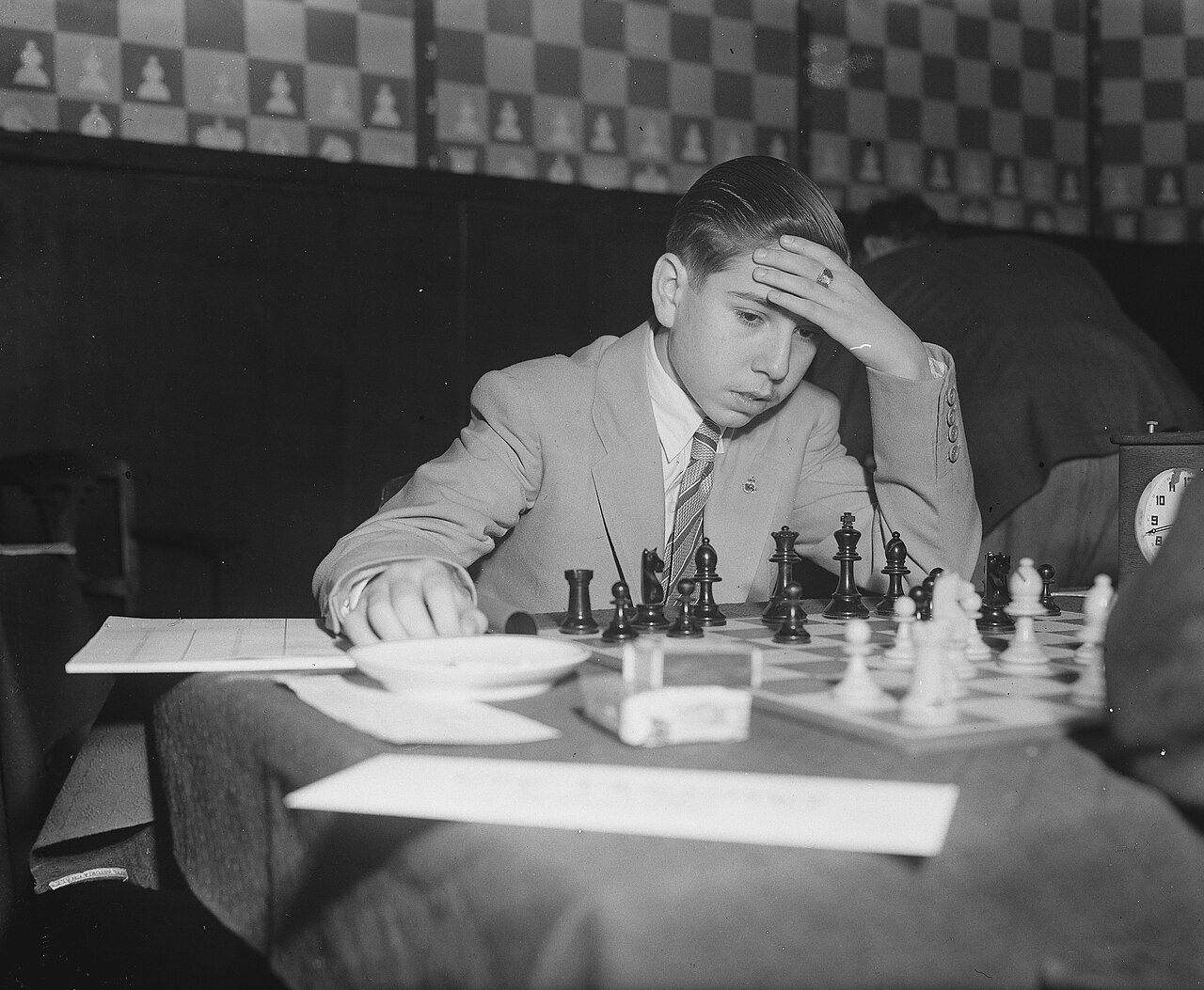
Mieses had himself played at Hastings in January 1946. He was the only surviving participant of the 1895 tournament with which the series had begun fifty years earlier.
When the two met at the Gambit Chess Rooms is not recorded. Two markers bracket the date. De nieuwe Nederlander places the two games after the London tournament, and the earliest known printing of the surviving game appeared on 16 March 1946 in De Groene Amsterdammer. Mieses, born on 27 February 1865, was therefore either eighty or eighty-one, depending on where in that window the match falls. The three columns that printed the game give his age as 81, 81 and 82.
The Nieuwsblad van het Noorden described the encounter as a meeting between the youngest and the oldest chess master in the world.
The Match
| Game | Colour | Opening | Result |
|---|---|---|---|
| surviving | Mieses | Sicilian Defence, 2.b3 | 0–1 Pomar |
| not found | not established | not established | Draw |
| Final score | Pomar 1½ – Mieses ½ | ||
None of the sources records which game was played first. Only one of the two has been found, the loss by Mieses with White. That the other was drawn follows from the final score; no report of it survives.
This was not the last of Mieses’ matches. In July 1946 a match against Willem Schelfhout followed in Amsterdam, which ended 2–2.
The Surviving Game
Mieses–Pomar, Sicilian Defence
Mieses had White and met 1...c5 with 2.b3, following up with g3 and bishops on both long diagonals. On move 19 Pomar took a pawn with 19...Nxd4 and never gave it back. After the queens came off, bishops of opposite colour remained, which made the win harder to force. With 34.Rxa7 Mieses reached for the last enemy pawn and allowed 34...Rc1+; after 35.Kg2 came 35...Rg1 mate. The annotations in the viewer are taken from the Dutch columns that printed the game.
Game details and notation
| White | Mieses, Jacques |
|---|---|
| Black | Pomar Salamanca, Arturo |
| Event | Wettkampf Mieses - Pomar, Gambit Chess Rooms, London |
| Date | 1946 |
| Opening | Sizilianische Verteidigung, 2.b3 (ECO B20) |
| Result | 0–1 |
| Source | De Groene Amsterdammer, Jg. 70, Nr. 11, 16. März 1946, S. 7; Nieuwsblad van het Noorden, 23. April 1946; Zutphensch dagblad, 18. Mai 1946 |
1. e4 c5 2. b3 2... d6 3. g3 Nf6 4. Bg2 g6 5. Bb2 Bg7 6. Ne2 Nc6 7. Nbc3 O-O 8. Nd5 Bg4 9. Nxf6+ exf6 10. f3 Bd7 11. O-O Re8 12. Nf4 Ne5 13. Nd5 f5 14. d4 14... Nc6 15. c3 cxd4 16. cxd4 Be6 17. Ne3 17... Qb6 18. exf5 18... Bxb3 19. Qd3 Nxd4 20. Kh1 Bc2 21. Nxc2 Qxb2 22. Nxd4 Qxd4 23. Qxd4 Bxd4 24. Rad1 Bc5 25. fxg6 hxg6 26. f4 26... Rab8 27. Rfe1 b6 28. Bc6 Rxe1+ 29. Rxe1 Kf8 30. f5 Rc8 31. Ba4 g5 32. f6 Bd4 33. Re7 g4 34. Rxa7 34... Rc1+ 35. Kg2 Rg1# 0-1
Notation in English algebraic form, as in the viewer.
Lodewijk Prins thought the outcome still open after 34.h4 or 34.Kg2. His explanation for the loss stands in the note to move 26:
"That Pomar nevertheless wins the game, and so quickly, must be put down to the fatigue of his very aged opponent."
A Textual Note
The three printings of the game disagree at move 29. De Groene Amsterdammer gives the black king move as Kf8–e8. The black king was in fact on g8, so neither the departure square nor the destination can be right. The Nieuwsblad van het Noorden and the Zutphensch dagblad both have Kg8–f8; of the two readings that have come down to us, only this one is legal. The PGN file follows it.
The complete score has been checked for legality with python-chess. It runs through without objection and ends in mate after 70 plies.
Open Questions
- The exact date of the match is unknown. All that is established is that it took place after the London tournament and before 16 March 1946.
- The order of the two games is not documented.
- The second game has not been found. Whether it was recorded at all is an open question.
Anyone able to add to any of these points, particularly from the British or Spanish chess press of 1946, is warmly invited to get in touch via the imprint.
Sources
- De Groene Amsterdammer, weekblad voor Nederland, vol. 70, no. 11, 16 March 1946, p. 7, column "schaken", signed L. Prins. The judgement translated above reads in the original: "Dat Pomar de partij toch, en zoo snel, wint moet aan vermoeidheid van zijn hoogbejaarden tegenstander worden toegeschreven."
- Nieuwsblad van het Noorden, 23 April 1946, chess column of the Noordelijke Schaakbond.
- De nieuwe Nederlander, The Hague, vol. 1, no. 288, 20 April 1946, p. 7, chess column "Het schaakwonderkind Arturito Pomar. Zijn loopbaan en prestaties".
- Zutphensch dagblad, 18 May 1946, column by A. van Steenis.
- D. J. Morgan, Quotes and Queries 3744, British Chess Magazine, September and October 1976.
All four Dutch papers are available through Delpher.
From the Upcoming Biography
The match against Arturo Pomar is covered in the Mieses biography by Johannes Geppert (coming spring 2027 from Hentrich & Hentrich Verlag Berlin Leipzig), in the context of his post-war years in London.
More about the biography & newsletter