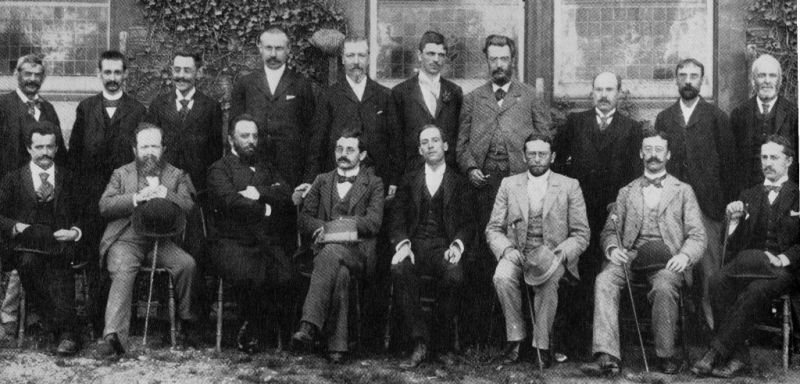
Hastings Chess Congress 1895
The "Tournament of the Century" – Mieses: 20th place (7½/21)
Tournament Overview
- Date: August 5 – September 2, 1895
- Venue: Brassey Institute, Hastings, England
- Patron: Duke of York
- Opening ceremony: John Watson (Chairman, Hastings Chess Club), Mayor Weston, MP Lucas Shadwell
- Format: Single round-robin, 22 players, 21 rounds
- Time control: 30 moves in 2 hours, then 15 moves/hour
- Playing days: Mon, Tue, Wed, Fri, Sat (1–5 pm and 7–10 pm); Thu for adjourned games
- Innovation: First use of round-by-round draw (instead of pre-tournament draw) to prevent collusion
- Winner: Harry Nelson Pillsbury (USA), 16½/21
- Mieses' result: 20th place (tied), 7½/21
Prize Fund
The prizes were substantial for the era. The Deutsche Schachzeitung converted them into German marks for its readers:
| Place | Prize (Marks) | approx. £ | Winner |
|---|---|---|---|
| 1st | 3,000 | £150 | Pillsbury |
| 2nd | 2,300 | £115 | Chigorin |
| 3rd | 1,700 | £85 | Lasker |
| 4th | 1,200 | £60 | Tarrasch |
| 5th | 800 | £35 | Steinitz |
| 6th | 600 | £30 | Schiffers |
| 7th (tied) | 400 | £20 | v. Bardeleben / Teichmann |
Additionally: 20 marks consolation per win for non-prize-winners, 40 marks for a win against the top three. Entry fee: 100 marks per player. Special prize: a gold ring for the most Evans Gambits accepted (won by Chigorin). Mieses' balance: with 4 wins he earned roughly 80 marks in consolation money – against a 100-mark entry fee, a net loss before travel and accommodation.
Historical Significance
The Frankfurter Zeitung published a feature article headlined "The New Battle of Hastings" – a reference to the famous Norman conquest of 1066. The parallel was apt: just as 1066 changed England forever, Hastings 1895 changed chess forever. For the first time, every leading player in the world competed in a single event.
Of the 38 masters who applied, the committee selected 22, allocated by nation: England 8 places (including Lasker and Teichmann, both German citizens playing under the English flag), Germany 4, Austria 2, Russia 2, America 4, France and Italy 1 each. The most notable exclusion was Szymon Winawer, who was refused permission to compete under a pseudonym.
There is a certain irony in the result: England organised the greatest chess tournament the world had ever seen, and not a single English player won a prize. All seven prizes went to continental Europeans and Americans. The Deutsche Schachzeitung noted with satisfaction that even Lasker and Teichmann – nominally playing for England – were German by birth.
The sensation of the tournament was the 22-year-old Pillsbury, competing in his first international event. His victory "through the power and elegance of his play" (DSZ) stunned the chess world. The German press declared that combinational chess, long dormant, had celebrated "its brilliant resurrection" in his hands.
Final Standings
| # | Player | Country | Points | Prize |
|---|---|---|---|---|
| 1 | Pillsbury | USA | 16½ | 1st Prize, £150 |
| 2 | Chigorin | Russia | 16 | 2nd Prize, £115 |
| 3 | Lasker | England* | 15½ | 3rd Prize, £85 |
| 4 | Tarrasch | Germany | 14 | 4th Prize, £60 |
| 5 | Steinitz | USA | 13 | 5th Prize, £35 |
| 6 | Schiffers | Russia | 12 | 6th Prize, £30 |
| 7–8 | v. Bardeleben | Germany | 11½ | 7th Prize (tied), £20 |
| 7–8 | Teichmann | England* | 11½ | 7th Prize (tied), £20 |
| 9 | Schlechter | Austria | 11 | |
| 10 | Blackburne | England | 10½ | |
| 11 | Walbrodt | Germany | 10 | |
| 12–14 | Burn | England | 9½ | |
| 12–14 | Janowski | France | 9½ | |
| 12–14 | Mason | England | 9½ | |
| 15–16 | Bird | England | 9 | |
| 15–16 | Gunsberg | England | 9 | |
| 17–18 | Albin | USA | 8½ | |
| 17–18 | Marco | Austria | 8½ | |
| 19 | Pollock | Canada | 8 | |
| 20–21 | Mieses | Germany | 7½ | |
| 20–21 | Tinsley | England | 7½ | |
| 22 | Vergani | Italy | 3 |
* Lasker and Teichmann competed for England but were German citizens. The DSZ commented: "Lasker and Teichmann are Germans too – their successes are laurels in the wreath of German chess glory."
Note: Schiffers (not Schlechter) received the 6th prize with 12 points. Schlechter, despite scoring 11, received nothing – prizes were capped at seven.
Source: Deutsche Schachzeitung, Vol. 50, No. 8 (August 1895), p. 249 (crosstable)
Mieses at Hastings 1895
The Deutsche Schachzeitung summed up Mieses' tournament bluntly: he had "not fulfilled the hopes raised by his early wins." Yet the paper also noted that he had drawn against Steinitz, Tarrasch, Lasker and Chigorin – and against Lasker had actually stood better at one point.
Those four draws against the world's top four players showed that Mieses could compete at the very highest level. His ten losses against the broader field revealed the inconsistency that would define his career throughout.
The Road to Hastings
Mieses arrived at Hastings after nine months of almost continuous travel: Russia (Moscow, St. Petersburg, Dorpat), Paris (match against Janowski at the Café de la Régence, January–February 1895), London (match against Teichmann at the British Chess Club and Metropolitan Chess Club, February 1895), a tour of England up to Glasgow (match against Taubenhaus, +2 −1 =2), and finally a visit to Tarrasch in Nuremberg in June 1895.
In Nuremberg, just six weeks before Hastings, Mieses gave a blindfold simultaneous display against six opponents – winning five and drawing one. The DSZ praised his play as "outstanding throughout." He arrived in top form.
After the Teichmann match, the DSZ had already warned that players tend to be "chess-saturated" immediately after a major event – and then easily "chess-mated." Nine months on the road may have taken their toll at Hastings.
Mieses' Games from Hastings 1895
Mieses – Blackburne 1-0
Mieses' most important win of the tournament: he defeated the veteran English master Joseph Henry Blackburne using a King's Indian setup now known as the Mieses Variation (1.d4 Nf6 2.c4 g6 3.f3) – a lasting contribution to opening theory that bears his name to this day.
Bird – Mieses ½–½
A positional struggle against the 65-year-old English veteran Henry Edward Bird, ending in a draw. Fifty-one years later, Mieses himself would sit across the board from young men at Hastings as an octogenarian – a remarkable symmetry.
View GameProblem-Solving Tournament – 3rd Prize
On 22 August, a problem-solving competition was held alongside the main event. Mieses won 3rd prize (20 marks) behind Georg Marco (1st, 60 marks) and Carl Schlechter (2nd, 40 marks) – a rarely noted detail that attests to his analytical abilities away from the board.
The Sole Survivor
Jacques Mieses was the last living participant of the legendary Hastings tournament of 1895. When he returned 50 years later, in 1945/46, to play at the Hastings Christmas Congress and won the brilliancy prize, all other 21 participants from 1895 had already passed away.
A unique bridge across half a century of chess history – from Victorian England to the post-war era.
Side Events
Alongside the masters' tournament, a main (amateur) tournament was held at the Queen's Hotel, beginning on 19 August with 32 players in four groups. The winner was Géza Maróczy of Budapest, who did not lose a single game – within two years he would be regarded as one of the strongest players in the world.
A ladies' tournament also took place: 20 players competed in a main and a subsidiary event, organised by Mrs W. J. Baird. In the main event, Miss Fox won with 4 points, followed by Lady Thomas, Miss Field and Miss Finn with 3½ each.
On the evening of 5 September, tournament winner Pillsbury gave a simultaneous display against 14 members of the Ladies Chess Club with knight odds – winning 11, losing 2, drawing 1.
The prize-giving ceremony took place on the afternoon of 3 September at the Brassey Institute and was conducted by Mrs Seyer-Milward.
Contemporary Voices
"The tournament at Hastings is the most significant that has ever taken place. Its brilliance eclipses even that of the London tournament of 1883."
"The Frankfurter Zeitung published a feature under the headline 'The New Battle of Hastings' – and the parallel was fitting. Just as the original battle of 1066 decided the fate of England, this tournament decided the future direction of chess."
Sources
- Deutsche Schachzeitung, Vol. 50, Nos. 2–8 (1895): tournament announcements (pp. 59, 124, 157–158, 188, 220), crosstable (p. 249), tournament report (pp. 251–264)
- Frankfurter Zeitung: "The New Battle of Hastings" (feature article, cited in DSZ No. 8)
- Cheshire, Horace F. (ed.): The Hastings Chess Tournament 1895, Chatto & Windus, 1896
- Hooper, David & Whyld, Kenneth: The Oxford Companion to Chess, Oxford University Press, 1992
- Winter, Edward: Chess Notes – articles on Hastings 1895 and Jacques Mieses
Other Tournaments
3rd Place – International Debut Breslau 1889
3rd Prize – first international master tournament Hastings 1895
Tournament of the Century Berlin 1897
Shared 3rd–4th Place Monte Carlo 1903
8th Place Cambridge Springs 1904
8th–9th Place Vienna 1907
1st Place – Greatest Victory! Ostend 1907
3rd–4th Place – World-Class Event San Sebastián 1911
Mieses as Organizer Liverpool 1923
1st Place – Tournament Victory! Baden-Baden 1925
New Beginning After the War Kemeri 1937
The Fateful Tournament Chess Olympiads
London 1927 · Prague 1931
Did You Know?
The Frankfurter Zeitung headlined its feature "The New Battle of Hastings" – a reference to the Norman conquest of 1066. The analogy works even better in English: both battles were fought on the same ground, and both changed history.
Chigorin won a gold ring as a special prize for accepting the most Evans Gambits – a prize that celebrated the romantic attacking tradition in chess.