Games Gallery
Jacques Mieses' tournament career of almost seven decades brought him together with all the great masters of his time. Whether against the dogmatic Tarrasch or the brilliant Rubinstein – Mieses' romantic attacking style always provided dramatic games and unforgettable moments.
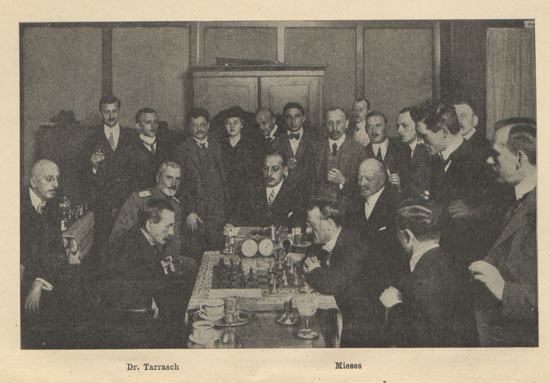
Dr. Siegbert Tarrasch against Jacques Mieses
Leipzig 1888 Nuremberg 1888 Breslau 1889
Dr. Siegbert Tarrasch (1862–1934) was the "Praeceptor Germaniae" – the teacher of Germany. As a doctor and chess theorist he influenced generations of players with his books like "Three Hundred Chess Games" (1895) and "The Modern Chess Game" (1912).
At the Augusteum Jubilee Tournament in Leipzig 1888 – Mieses' first major master tournament – came the memorable encounter: The 23-year-old Mieses defeated the favored Tarrasch with the Vienna Game! Tarrasch himself later wrote about this tournament that he had believed it was enough "to sit at the board and make moves to win."
At Nuremberg 1888 Tarrasch took revenge, but already in Breslau 1889 they crossed swords again. The rivalry between Tarrasch's scientific style and Mieses' romantic attacking play embodied the generational conflict in German chess.
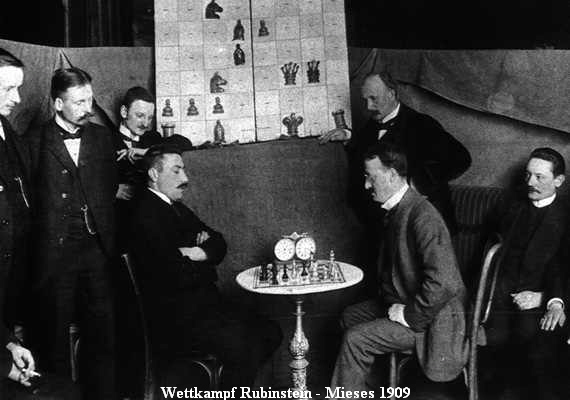
Akiba Rubinstein against Jacques Mieses
Berlin 1909 Match
Akiba Rubinstein (1880–1961) was considered the "Master of Endgames" – his positional understanding was legendary. In 1909 he seemed invincible: tournament victory in Karlsbad 1907, shared first place in St. Petersburg 1909 with World Champion Lasker, and a victory against Lasker himself!
The match in Berlin (May 1909) was supposed to be a "triumphal march" for Rubinstein. But then the unexpected happened: Mieses won the first three games! The chess world was shaken – the man who had lost only one game all year now lost three in a row to the "romantic" Mieses.
However, Rubinstein found his way back to form and won the rest of the match convincingly with +5 =2 -0. Final score: Rubinstein 6 – Mieses 3 (with 2 draws). The match showed that even the most precise technician was vulnerable to Mieses' unpredictable attacking style.
Two Worlds of Chess
The "Scientific School"
Tarrasch and Rubinstein represented the positional, logical style. Every move should follow a clear plan. Tarrasch formulated rules like: "Rooks belong behind passed pawns" and emphasized piece activity above all.
The "Romantic School"
Mieses remained faithful throughout his life to the tradition of Anderssen and Morphy: sacrifice, attack, king hunt! His games were works of art, even if they didn't always win. He was the last great representative of this dying school.
"Rubinstein is the greatest artist among chess players. His games give the impression of a great building from which one cannot move a single stone."
The year 1909 was a highlight of the classical chess era. The great Chigorin Memorial Tournament in St. Petersburg (February/March 1909) assembled the elite: Lasker, Rubinstein, Schlechter, Spielmann, Bernstein, Teichmann – and Mieses. The tournament honored the deceased Russian master Mikhail Chigorin (1850–1908).
Mieses achieved a respectable middle place in St. Petersburg, but his victory against Carl Schlechter with the Scandinavian Defense became legendary. Directly after the tournament followed the sensational match against Rubinstein in Berlin – a triumphant conclusion to a memorable season.