Chess Textbook
The Standard Work of German Chess Literature
The "little Dufresne" – as this work is affectionately nicknamed – has taught generations of chess players the royal game for over 140 years. With more than 30 editions and hundreds of thousands of copies sold, it is one of the most successful chess books of all time.
Lehrbuch des Schachspiels
since 1881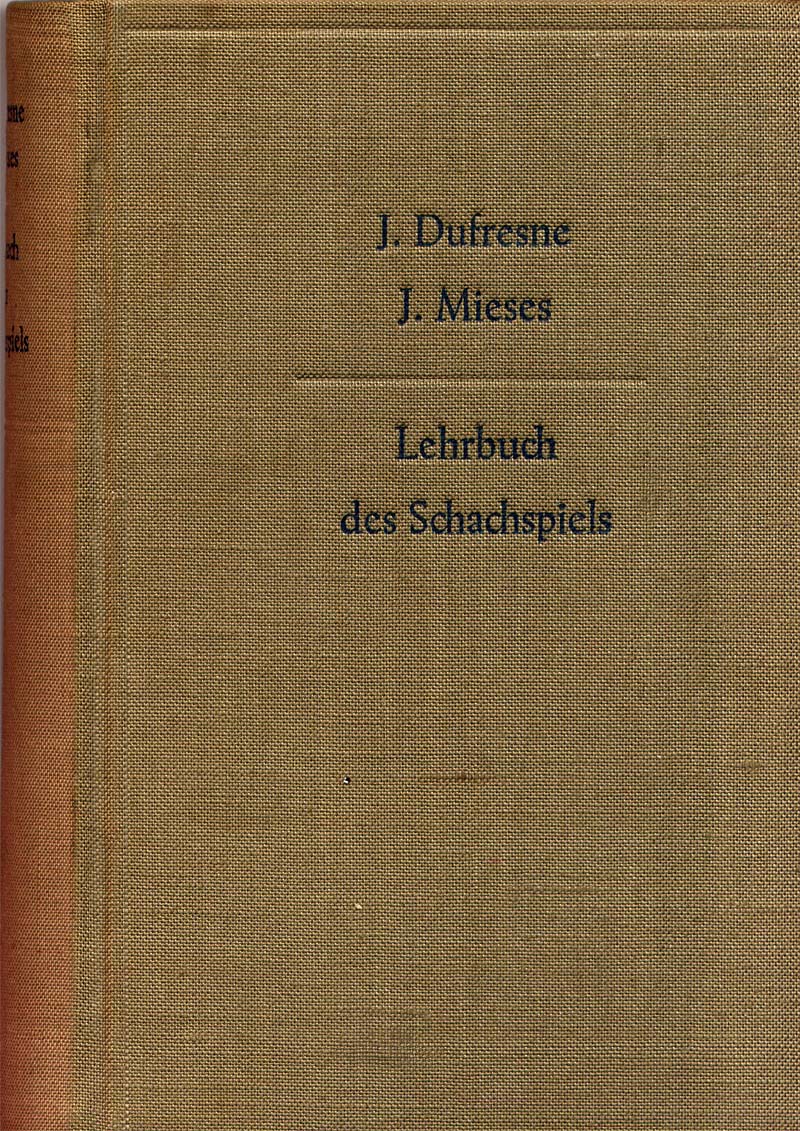 Click to enlarge
| Title | Lehrbuch des Schachspiels (Chess Textbook) |
|---|---|
| Nickname | "The little Dufresne" |
| Authors | Jean Dufresne & Jacques Mieses |
| Publisher | Philipp Reclam jun. (Universal Library) |
| Location | Leipzig (later Stuttgart) |
| First Edition | 1881 |
| Editions | Over 30 (31st edition 2004) |
| Category | Comprehensive textbook |
Structure of the Work
The book is divided into three main parts: a detailed explanation of the basic rules of the game, a comprehensive introduction to opening theory with annotated master games, and a section on the endgame. This is supplemented by a historical overview of the most important names, tournaments and matches in chess history.
The Erased Name (1933–1945)
The book did not disappear after 1933 — its editor did. The Propaganda Ministry blocked further editions under the name of its Jewish author. The last edition Mieses prepared himself was the 14th of 1937; the 15th (1941) and 16th (1943) appeared without any involvement of his, edited by Max Blümich (1886–1942) — the 16th even posthumously.
Only after the war did Mieses return to his own work. For the 17th edition he restored the original text and modernised it at the same time — as he described himself in the preface to that edition and in his letters. He spent several weeks in Berlin in the autumn of 1949 to do so, as recorded in the Deutsche Schachblätter interview of October 1949.
History of the Work
Jean Dufresne (1829–1893)
The Berlin chess master and writer Jean Dufresne wrote the first edition in 1881 for Reclam's Universal Library. He edited editions 1–6 until his death in 1893. Dufresne is best known as Adolf Anderssen's opponent in the famous "Evergreen Game" (1852).
Jacques Mieses Takes Over (from 1901)
For the 7th edition (1901), the publisher recruited Jacques Mieses, who was known for his brilliant play and excellent reputation as a chess journalist. Mieses supervised the textbook for over five decades until 1952 and shaped it so sustainably that it has since rightfully appeared under the joint authorship "Dufresne-Mieses."
Later Editors
After Mieses' death (1954), Rudolf Teschner took over the editing and continued the work until the 31st edition (2004). In the 19th edition, Berlin master Kurt Richter also contributed annotated games.