The Chess Pilot
Click to enlarge
Bibliographic Information
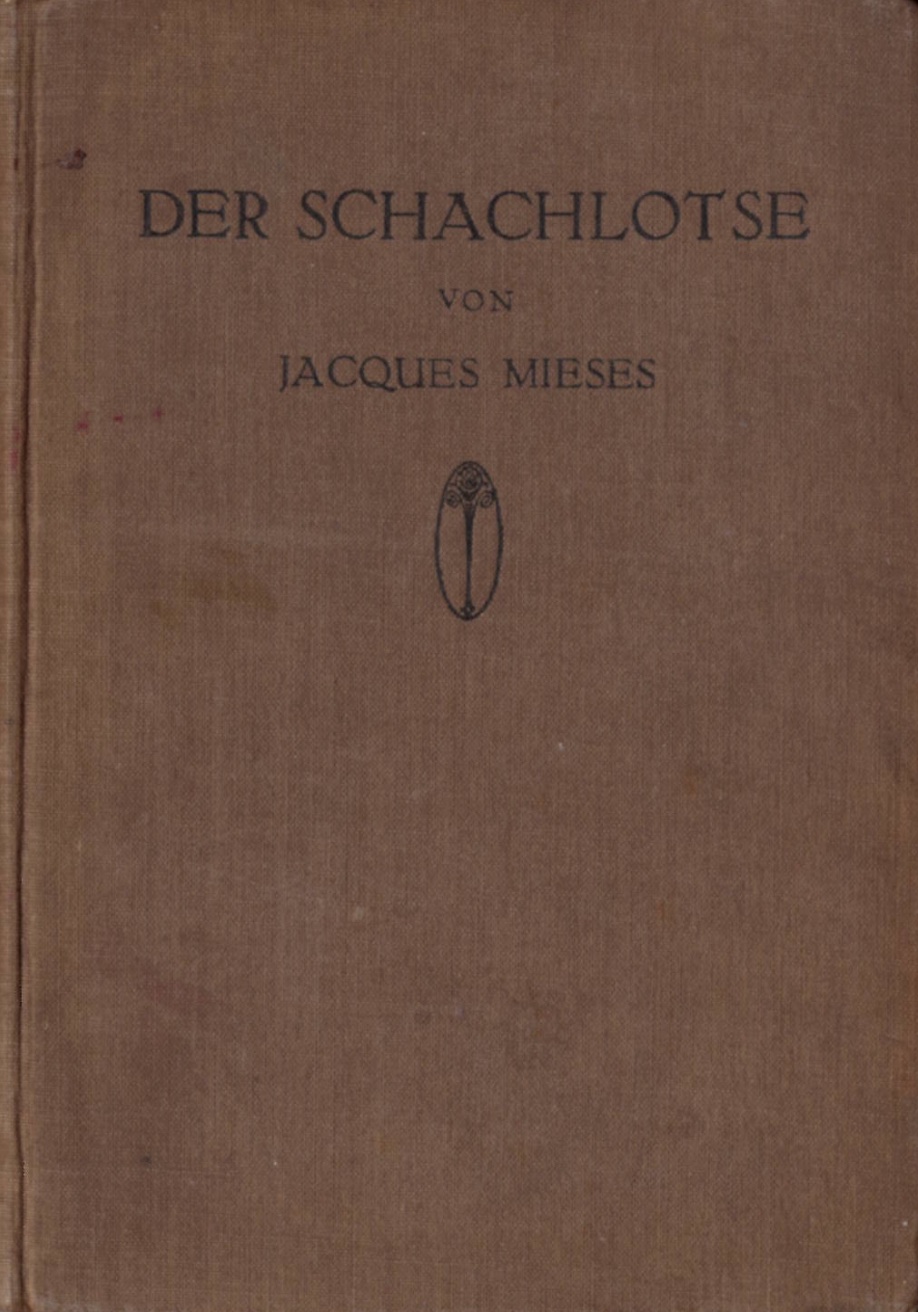
| Title: | Der Schachlotse (The Chess Pilot) |
|---|---|
| Subtitle: | A bridge in opening play for theoretically inexperienced chess friends |
| Author: | Jacques Mieses |
| Publisher: | Hans Hedewig's Nachf. (Curt Ronniger), Leipzig |
| First Edition: | ca. 1916 |
| Editions: |
1st ed. (~1916), 2nd ed. (1916), 3rd ed. (1920), 5th ed. (1934)
At least 5 editions documented |
| Category: | Opening Theory Beginners |
The Pilot – A Perfect Metaphor
The title "Chess Pilot" is a wonderfully chosen metaphor: Just as a pilot safely navigates a ship through dangerous waters, shallows and harbor entrances, this book was meant to guide the chess amateur safely through the "labyrinthine network of variations" of opening theory.
Mieses recognized that the rapidly growing opening theory overwhelmed many players. Instead of encyclopedic completeness, he offered a practical "bridge" – a navigation system that worked even without deep knowledge of variations.
From the Preface
"An guten Lehrbüchern ist in der Schachliteratur wahrlich kein Mangel, ebenso wenig fehlt es an grossen schachtheoretischen Werken, die das weite Feld der Eröffnungen gründlich und systematisch behandeln. Aber der lernbegierige Schachfreund [...] macht meist gar bald eine deprimierende Erfahrung. Die Lehre von den Schacheröffnungen bildet heutzutage ein so ausgedehntes und kompliziertes Gebiet, dass selbst der begabteste, mit einem glänzenden Schachgedächtnis ausgestattete Amateur ein langes Studium braucht, ehe er sich auch nur einigermassen darin zurechtfindet."
English Translation:
"There is truly no shortage of good textbooks in chess literature, nor is there a lack of great theoretical works that treat the wide field of openings thoroughly and systematically. But the eager chess student [...] usually soon makes a depressing discovery. The theory of chess openings nowadays forms such an extensive and complicated field that even the most gifted amateur, equipped with a brilliant chess memory, needs long study before he can even somewhat find his way around in it."
The Problem
Mieses aptly describes the frustration of many amateurs:
- Opening theory constantly grows and becomes ever more complicated
- The "labyrinthine network of variations" confuses the learner
- It goes "like a mill wheel in the head"
- Despite study, little playing strength is gained
- In practical play, the memorized variations fail
The Solution
The Chess Pilot offers a different approach:
- No encyclopedic flood of variations
- Practical orientation instead of theoretical depth
- Understanding the principles behind the moves
- "Bridge" for players without time for intensive study
- Focus on the most important position types and their treatment
The Chess Pilot – English Edition
After his emigration to England in 1938, Mieses translated his popular work into English. "The Chess Pilot" was published in 1947 by Williams & Norgate in London – Mieses was already 82 years old at this time.
Together with "Manual of the End Game" and "Instructive Positions from Master Chess" it formed a trio of English-language books that, according to British Chess News, enjoyed "a long and wide popularity in English."
| Title: | The Chess Pilot |
|---|---|
| Publisher: | Williams & Norgate |
| Location: | London |
| Year: | 1947 |
Timeless Relevance
Mieses' observation from 1916 is more relevant today than ever: Opening theory has grown exponentially through computers and databases. Modern players face the same problems as Mieses' contemporaries – only on an even larger scale.
His approach of teaching principles instead of variations is the basic idea of modern opening instruction books like John Watson's "Mastering the Chess Openings" or Jeremy Silman's works. Mieses was ahead of his time.
Known Editions
| Edition | Year | Publisher | Language |
|---|---|---|---|
| 1st Edition | ~1916 | Hedewig's Nachf., Leipzig | DE |
| 2nd Edition | 1916 | Hedewig, Leipzig | DE |
| 3rd Edition | 1920 | Ronniger, Leipzig | DE |
| 5th Edition | 1934 | Hedewig, Leipzig | DE |
| The Chess Pilot | 1947 | Williams & Norgate, London | EN |
The 4th edition has not yet been documented; possibly additional editions exist.