"I Played Against Five World Champions!"
Conversation with the World's Oldest Active Chess Master
In the autumn of 1949 Jacques Mieses spent several weeks in Berlin — his first extended stay in Germany since emigrating in 1938. The occasion was work on the 17th edition of the “Dufresne”, the textbook he had edited since 1901 and which had appeared without him throughout the Nazi years. While there, the 84-year-old gave this interview to the Deutsche Schachblätter.
"I Played Against Five World Champions!"
October 1949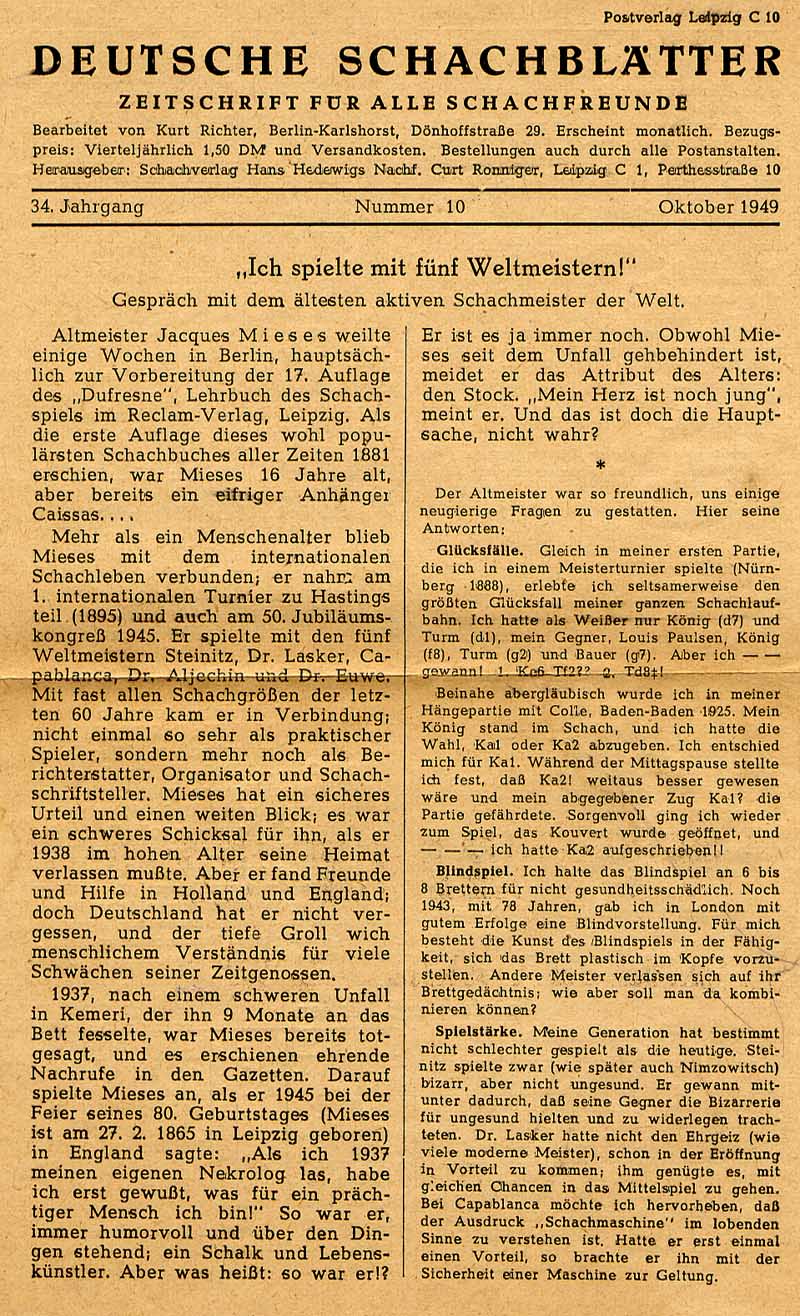 Part 1 – Title Page
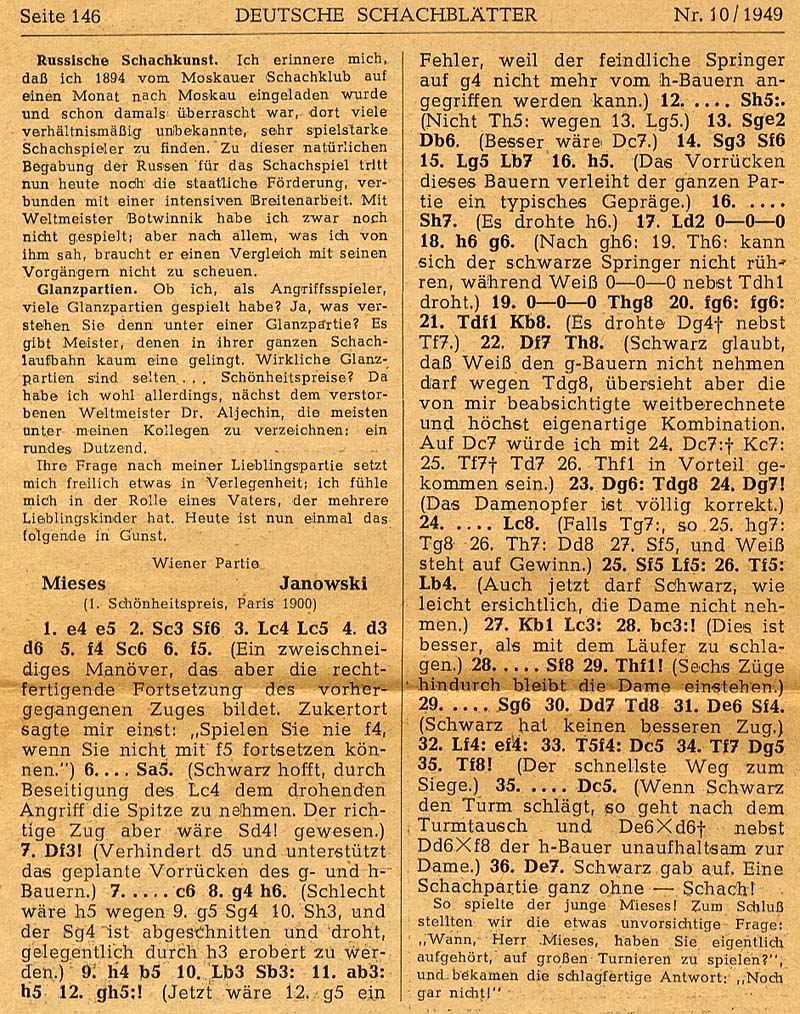 Part 2 – Page 146
Click on the images to enlarge
| Magazine | German Chess Magazine |
|---|---|
| Issue | 34th Year, No. 10, October 1949 |
| Editor | Kurt Richter, Berlin-Karlshorst |
| Publisher | Chess Publishing Hans Hedewigs Nachf. Curt Ronniger, Leipzig |
| Pages | Title page + Page 146 |
|---|---|
| Type | Interview |
| Price (1949) | 1.50 DM quarterly |
Steinitz
Dr. Lasker
Capablanca
Dr. Alekhine
Dr. Euwe
Mieses was not only a player, but also a reporter, organizer and chess writer – he knew these masters on many levels.
What Mieses said
Kurt Richter, who edited the Deutsche Schachblätter, put six subjects to the old master. His answers are summarised here; the quotations are translated from the original reproduced above, with the German wording given where it matters.
Strokes of luck
In the very first game he ever played in a master tournament — against Louis Paulsen at Nuremberg 1888 — Mieses experienced what he called the greatest stroke of luck of his career. He had only king and rook left; Paulsen had king, rook and a pawn, an ending that cannot be won. It finished 1.Kc6 Rf2?? 2.Rd8+, and Mieses won.
The second came at Baden-Baden 1925. In an adjourned game against Edgard Colle his king was in check and he sealed Ka1. Over the lunch break he worked out that Ka2 would have been far better and that his sealed move put the game at risk. He returned to the board “full of worry” — and the envelope contained Ka2.
Blindfold play
At six to eight boards Mieses considered blindfold play harmless; as late as 1943, aged 78, he gave a blindfold display in London. His explanation of how he managed it sets him apart from many colleagues:
"For me the art of blindfold play lies in the ability to picture the board three-dimensionally in one's head. Other masters rely on their memory of the board — but how is one then supposed to calculate combinations?"
The generations compared
Asked whether the old players had been weaker, he replied that his generation “certainly did not play worse than today's”. Steinitz played bizarrely, he said, but not unsoundly — and sometimes won precisely because opponents mistook the oddity for a mistake and set out to refute it. Of Lasker, whom he had faced himself in 1889/90, he observed that he had no ambition to gain an advantage out of the opening; equal chances going into the middlegame were enough for him. And of Capablanca he insisted that the word “chess machine” was meant as praise: once he held an advantage, he converted it “with the reliability of a machine”. It was Mieses himself who had made Capablanca's international breakthrough possible — as tournament director of San Sebastián 1911.
Russian chess
In 1894 the Moscow Chess Club had invited Mieses for a month, and even then he was struck by how many strong, internationally unknown players he found there. By 1949, he said, state support had been added to the natural talent. He had never played Mikhail Botvinnik, the reigning world champion, but from everything he had seen, Botvinnik need not fear comparison with his predecessors.
Brilliancies and brilliancy prizes
Asked about his brilliant games, Mieses answered with a question of his own — what did the interviewer mean by a brilliancy? There were masters who never managed one in an entire career; genuine brilliancies were rare. On brilliancy prizes he was more definite: next to Alekhine, who had died in 1946, he had won more of them than any of his colleagues — “a round dozen”. That statement is the source for the figure which appears elsewhere on these pages as an estimate.
Mieses – Janowski
Vienna Game 1st Brilliancy Prize Paris 1900
Asked to name his favourite game, Mieses compared himself to a father with several favourite children — “today it happens to be the following one”. There follows the complete notation with his own annotations, among them the remark that the queen sacrifice on move 24 is “entirely correct”. The game ends, as he puts it, as “a game of chess entirely without — check!”
The annotations on our game page come from this very article.
"When, Mr. Mieses, did you actually stop playing in major tournaments?"
- Born: February 27, 1865 in Leipzig
- 1881: First edition of "Dufresne" (Mieses 16 years old)
- 1895: First international tournament Hastings
- 1937: Kemeri accident (9 months bedridden)
- 1938: Emigration to Holland and England
- 1945: 50th Anniversary Congress Hastings