A Life for Chess
A Life for Chess
October 1947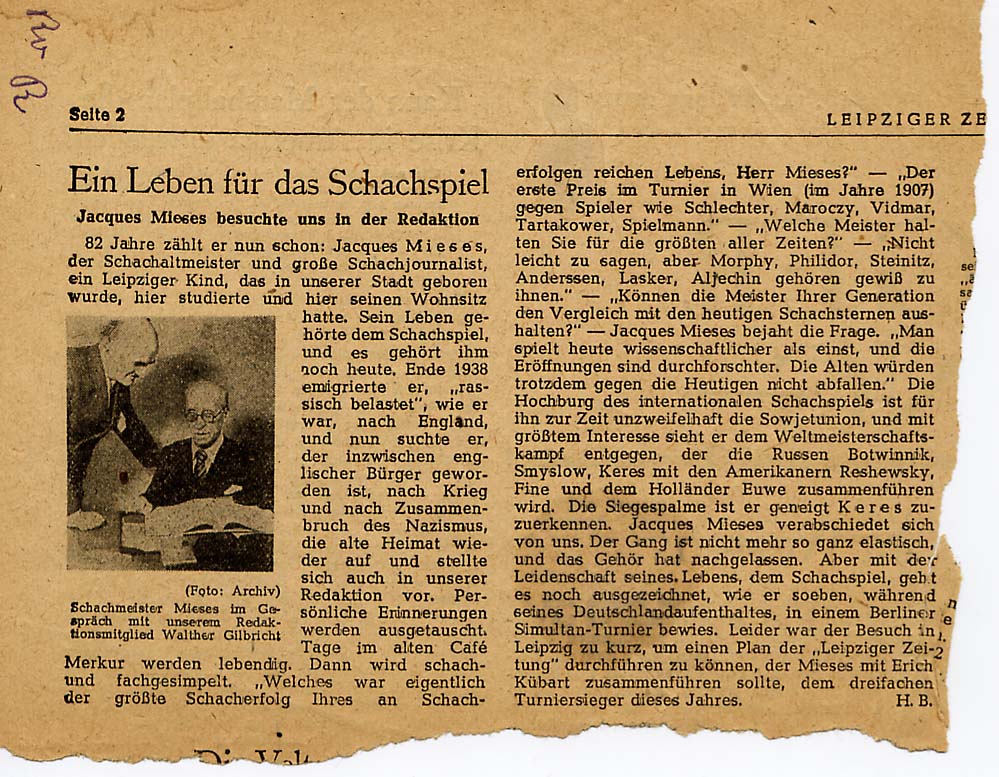 Click to enlarge
| Newspaper | Leipziger Zeitung |
|---|---|
| Period | October 1947 (see below) |
| Page | 2 |
| Author | H.B. |
| In the photo | Walther Gilbricht, member of the editorial staff |
| Type | Interview |
"Jacques Mieses visited us in the editorial office"
Historical Context
A special moment: The 82-year-old Mieses returned to his birthplace Leipzig after the war and visited the editorial office of the Leipziger Zeitung. An emotional reunion with the city he had had to leave at the end of 1938 — “racially tainted”, as the article puts it in the Nazi idiom of the day.
What Mieses said in the newsroom
The piece is not a set interview but an editorial report with questions and answers woven in. It is signed “H. B.”; Walther Gilbricht, who stands beside Mieses in the photograph, was a member of the editorial staff.
His greatest success
Asked about the greatest success of his life, Mieses answered without hesitation: “First prize at the tournament in Vienna (in 1907), against players like Schlechter, Maróczy, Vidmar, Tartakower, Spielmann.” He had given the same answer a year earlier to the same paper for its survey of chess in Leipzig.
The greatest masters of all time
Asked whom he considered the greatest, he replied: “Not easy to say, but Morphy, Philidor, Steinitz, Anderssen, Lasker, Alekhine certainly belong among them.” What stands out is the omission — Capablanca, against whom he had played himself.
Old masters and new
Asked whether his own generation could stand comparison with the players of the day, he said yes: “Chess is played more scientifically now than it once was, and the openings are better researched. The old masters would nevertheless not come off worse against today's.” Two years later he repeated the judgement almost word for word to the Deutsche Schachblätter.
A forecast that missed
The stronghold of international chess was for him, in 1947, “unquestionably the Soviet Union”. He looked forward “with the greatest interest” to the coming world championship tournament — Botvinnik, Smyslov, Keres, Reshevsky, Fine and Euwe — and picked Keres to win. Botvinnik won it in 1948. Mieses wrote his own account of how that tournament came about in 1949.
A meeting that never happened
The paper closes with regret that the visit had been too short for a plan of its own: to bring Mieses together with Erich Kübart, “three times a tournament winner this year”. Of Mieses himself it notes soberly that his step was “no longer quite so springy” and his hearing had declined — but that chess was going excellently, as he had just shown in a simultaneous display in Berlin.
Where the date comes from
The cutting carries no date — the masthead is torn off at the edge. Four details narrow it down all the same: Mieses “is 82 years old” (he was, from 27 February 1947 to 26 February 1948); he “has meanwhile become an English citizen” (he took the oath on 18 June 1947); the world championship tournament still lies ahead (it began on 2 March 1948); and his journey to Germany took place in September and October 1947. That leaves October 1947.
About the paper: the Leipziger Zeitung was a licensed newspaper of the Soviet occupation zone and appeared only from 1946 to 1948. It is not the present-day paper of the same name.