The World Championship in Chess
An Article by Jacques Mieses
Jacques Mieses wrote this article himself — at the age of 84, from exile in London. In it he traces the history of the world chess championship from London 1851 to the moment when, after Alekhine's death, the title was ownerless for the first time. He does not write as a second-hand chronicler: he had seen Steinitz at the board and had played Lasker, Capablanca, Alekhine and Euwe.
The World Championship in Chess
By J. Mieses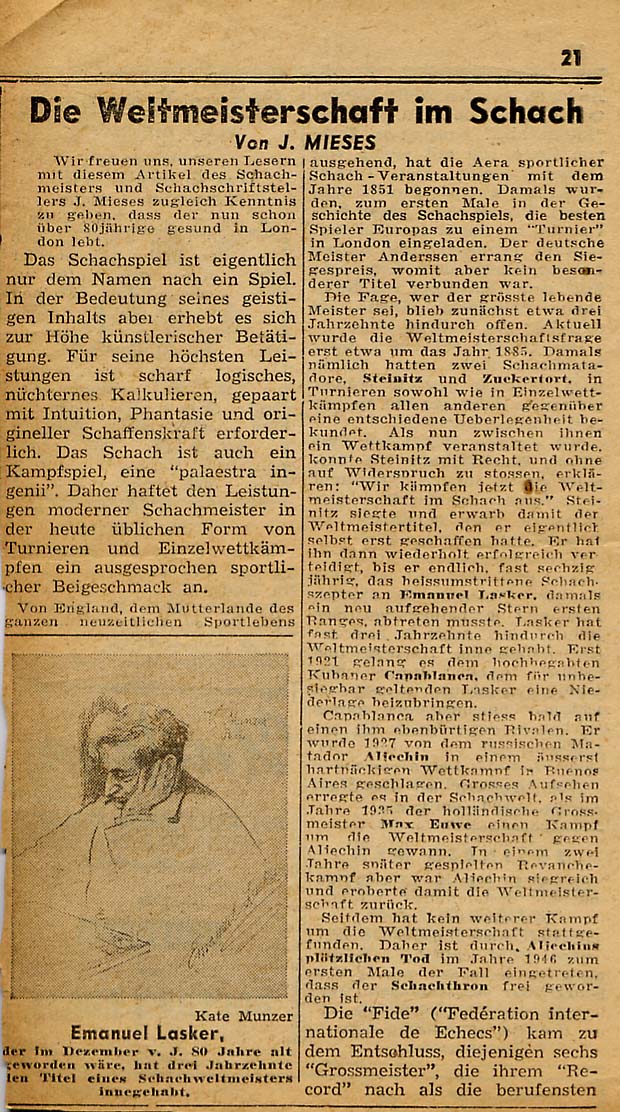 Click to enlarge
| Title | The World Championship in Chess |
|---|---|
| Author | J. Mieses |
| Period | 1949 (see below) |
| Page | 21 |
| Illustration | Drawing by Kate Munzer |
| Type | Own Article |
Where the date comes from
The cutting carries no date, but the caption supplies one: Lasker “would have turned 80 last December”. He was born on 24 December 1868, so that 80th birthday would have fallen in December 1948. The article therefore dates from 1949.
What the article says
Mieses does not begin with the champions but with the question of what chess actually is. It is, he writes, “only a game in name”; in the significance of its intellectual content it rises “to the level of artistic activity”. What its highest achievements demand is “sharply logical, sober calculation, coupled with intuition, imagination and original creative power”. At the same time chess is a contest, a palaestra ingenii — a wrestling school of the mind. From that, he argues, comes the sporting flavour that tournaments and matches lend the game.
1851: a beginning without a title
Mieses dates the era of sporting chess events to 1851, when the strongest players in Europe were invited to a tournament in London — from England, “the mother country of all modern sporting life”. Adolf Anderssen won, “though no particular title went with it”. Who the strongest living master was remained open for some three decades.
Steinitz invents the title he then wins
The question became live, in his account, only “around the year 1885”, when Wilhelm Steinitz and Johannes Zukertort had shown themselves superior to everyone else. Before their match Steinitz could declare, without meeting contradiction:
"We are now playing for the world championship in chess."
„Wir kämpfen jetzt die Weltmeisterschaft im Schach aus."
Steinitz won — and thereby acquired, as Mieses drily notes, a title “which he had in fact created himself”. He defended it repeatedly until, “almost sixty”, he had to surrender it to Emanuel Lasker, then “a newly rising star of the first rank”.
From Lasker to the empty throne
Lasker held the title for almost three decades. Only in 1921 did Capablanca manage to inflict a defeat on the Lasker who had “until then been considered unbeatable”. Capablanca in turn lost to Alekhine at Buenos Aires in 1927. The victory of the Dutchman Max Euwe in 1935 caused a sensation — two years later Alekhine took the title back in the return match.
After that no further match came about. Alekhine's sudden death in 1946 therefore produced, for the first time in the history of chess, the situation “that the chess throne has become vacant”. At this point the article turns to how FIDE intended to resolve it — with a tournament among the six grandmasters best qualified by record. There the surviving cutting breaks off; the continuation was on a further page that has not been preserved.
For context: the tournament FIDE organised was held in 1948 at The Hague and Moscow and was won by Mikhail Botvinnik. Mieses is thus writing about an event already decided by the time of publication — the article explains its prehistory to his readers.
Mieses as Chess Journalist
Jacques Mieses was not only a player, but also a productive chess author. He wrote numerous tournament books (including the official book on San Sebastián 1911), textbooks for Reclam, and regularly wrote articles for various newspapers. His analyses and historical reviews were very popular with readers.
View Mieses' Books