Mieses at the Chess Olympiads
From the first Olympiad in 1927 to guest of honor in Prague 1931 — Mieses' connection to the team battles of nations.
The Chess Olympiads began in 1927 as a FIDE competition of nations and quickly established themselves as the most important team championship in chess. Jacques Mieses belonged to the generation that co-founded and shaped this tradition.
His Olympiad history reflects the generational change in German chess: from active regular player in London 1927 to honored observer in Prague 1931.
London 1927 — The First Chess Olympiad
Tournament Overview
- Date: July 18–29, 1927 (closing ceremony July 30)
- Location: Westminster Central Hall, London
- Participants: 16 nations
- Winner: Hungary (Maróczy, Nagy, Vajda, E. Steiner, Havasi)
- Germany: 6th place (34 game points, level with Austria; OlimpBase places Germany ahead on match points — 20 to 19 — while the direct encounter ended 2–2. Contemporary reports sometimes list Germany 7th.)
The German team played with the lineup Tarrasch (board 1), Mieses (board 2), Carls (board 3), and Wagner (board 4). Germany was one of the few teams without a reserve player — all four contested every one of the 15 rounds in the same board order.
Individual Results — Germany
| Board | Player | W | D | L | Points |
|---|---|---|---|---|---|
| 1 | Tarrasch | 4 | 9 | 2 | 8½/15 |
| 2 | Mieses | 5 | 6 | 4 | 8/15 |
| 3 | Carls | 7 | 5 | 3 | 9½/15 |
| 4 | Wagner | 4 | 8 | 3 | 8/15 |
| Team total | 34/60 | ||||
Carl Carls was Germany's strongest player in London with 9½ points. Mieses achieved a balanced result on board 2 with five wins against four losses.
Meanwhile in Magdeburg
While the Olympiad was under way, on the evening of 24 July 1927, the German Chess Federation awarded its Bundesmedaille for services to German chess to twelve men at its jubilee congress in Magdeburg. Mieses was ninth on the list. He could not accept it in person: 24 July was the only rest day of the Olympiad, and he was in London. The same federation assembly resolved to send the German team a telegram of thanks. (Magdeburg 1927 congress book, pp. 29-31)
Prehistory: Paris 1924
In July 1924, the 1st unofficial Chess Olympiad was held in Paris alongside the Summer Olympics — the first international team chess tournament of its kind. 18 nations sent three players each to the Hôtel Majestic. On the final day of the tournament, July 20, 1924, FIDE was founded at the same venue.
Germany, however, was barred from the event — as from the Olympic Games themselves — as a consequence of World War I. Mieses therefore could not represent his country until three years later, at the 1st official Chess Olympiad in London 1927.
Result Paris 1924: Czechoslovakia (31 pts.) ahead of Hungary (30) and Switzerland (29). Individual champion: Hermanis Matisons (Latvia).
Prague 1931 — Mieses as Guest of Honor
Tournament Overview
- Date: July 11–26, 1931
- Location: Café in the U Nováků palace, Vodičkova Street, Prague (near Wenceslas Square)
- Participants: 19 nations (22 registered)
- Winner: USA (Kashdan, Marshall, Dake, Horowitz, H. Steiner)
- Germany: 5th place (Bogoljubov, Ahues, Wagner, Richter, Helling)
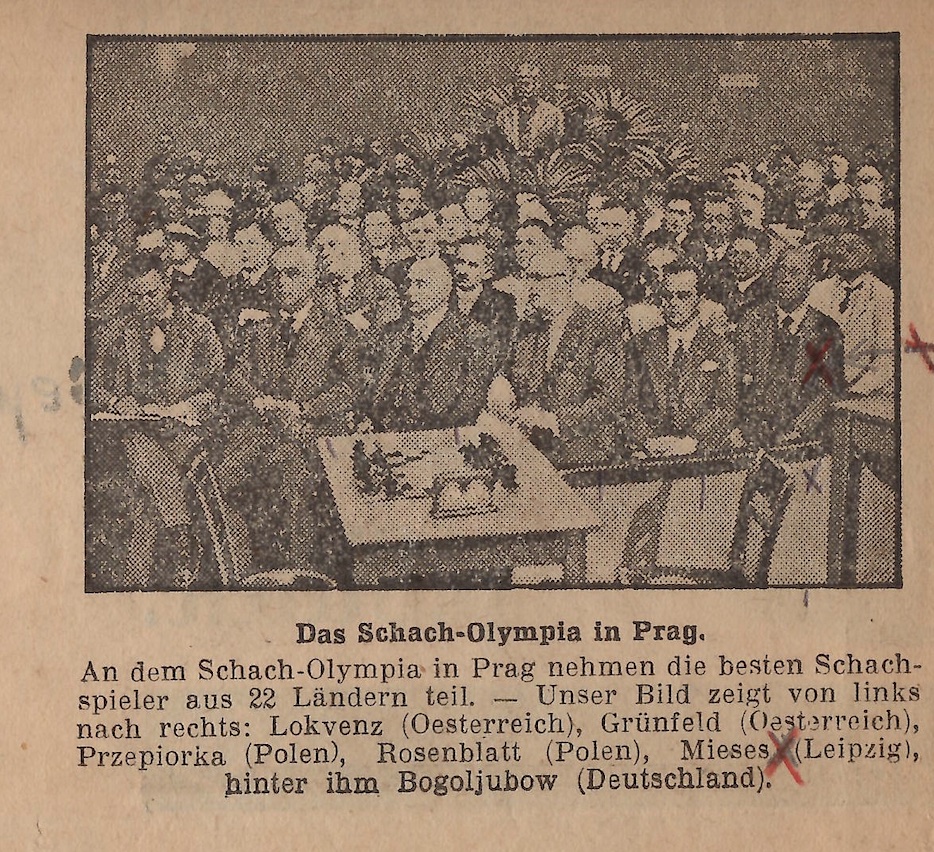
Note: Names follow the original newspaper caption. No Rosenblatt was part of the Polish Olympiad team (Rubinstein, Tartakower, Przepiórka, Makarczyk, Frydman); his role remains unclear.
Mieses was not part of the German team in Prague 1931. The team had rejuvenated: Bogoljubov on top board, Ahues, Wagner, Richter, and Helling formed the new generation.
Mieses was present as guest of honor and observer — the newspaper caption identifies him as "Mieses (Leipzig)" rather than "Mieses (Germany)". Bogoljubov won the individual silver medal on top board (+9 −1 =7).
The image impressively shows the generational change: Mieses, once a regular player on the German national team, now in the audience as a respected guest of honor.
The Generational Change
The transformation between London 1927 and Prague 1931 illustrates the upheaval in German chess. The "romantic generation" — Tarrasch, Mieses, Carls — gave way to the "new ones": Bogoljubov, Ahues, Richter.
Tarrasch died in 1934, Mieses emigrated to England in 1938. The Olympiads document not only sporting achievements but also the transition from one chess era to the next.
More on the history of German chess: German Chess History and Chess and Emigration.
Sources and Further Links
- OlimpBase: Unofficial Olympiad Paris 1924
- OlimpBase: 1st Chess Olympiad London 1927
- Wikipedia: 1st Chess Olympiad 1927
- Wikipedia: 4th Chess Olympiad 1931
- OlimpBase: Prague 1931 — Poland team
- Wikipedia (DE): Schacholympiade 1931 (venue)
- Árpád Földeák: Chess Olympiads 1927–1968 (Budapest 1979)
- Congress book: Der fünfundzwanzigste Kongress (Jubiläums-Kongress) des Deutschen Schachbundes in Magdeburg 1927, hrsg. von W. Frhr. von Holzhausen, Berlin: Schachverlag Bernhard Kagan 1927, S. 29-31
Other Tournaments
International Debut Breslau 1889
3rd Prize – first international master tournament Hastings 1895
Tournament of the Century Berlin 1897
Shared 3rd–4th Place Monte Carlo 1903
8th Place Cambridge Springs 1904
8th–9th Place Vienna 1907
1st Place – Greatest Victory! Ostend 1907
3rd–4th Place – World-Class Event San Sebastián 1911
Capablanca's Breakthrough Liverpool 1923
1st Place – Tournament Victory! Baden-Baden 1925
New Beginning After War Kemeri 1937
The Fateful Tournament Chess Olympiads
London 1927 · Prague 1931