International Chess Tournament at San Sebastián 1911
Mieses' Organizational Masterpiece – Capablanca's International Breakthrough
Tournament Overview
- Date: February 20 – March 17, 1911
- Venue: Grand Casino, San Sebastián (Donostia), Basque Country, Spain
- Host: Grand Casino San Sebastián under director Georges Marquet ("M. Marquet")
- Tournament Director: Jacques Mieses
- Format: Single round-robin, 15 players, 14 rounds
- Time Control: 1 hour for 15 moves
- Winner: José Raúl Capablanca (CUB), 9½/14
- Mieses' Role: Tournament director and organizer (not a player!)
Mieses as Tournament Revolutionary
Tournament organizer Jacques Mieses introduced the custom of "hospitality" at San Sebastián. He convinced the casino management under director Georges Marquet to reimburse all players for their travel expenses and to provide them with free board, lodging, and meal money. Before 1911, chess masters had to cover their own costs — a significant financial risk that excluded less wealthy players from elite events.
Mieses understood the needs of elite players. His innovation became the standard for all subsequent international top-level tournaments and laid the foundation for professional tournament chess.
"He convinced the tournament's sponsor to reimburse the players for their travel expenses and to give them free board and lodging" (Hooper & Whyld, The Oxford Companion to Chess, 1992). See also Andy Soltis' foreword to Robert Irons, San Sebastian 1911 (Russell Enterprises, 2024).
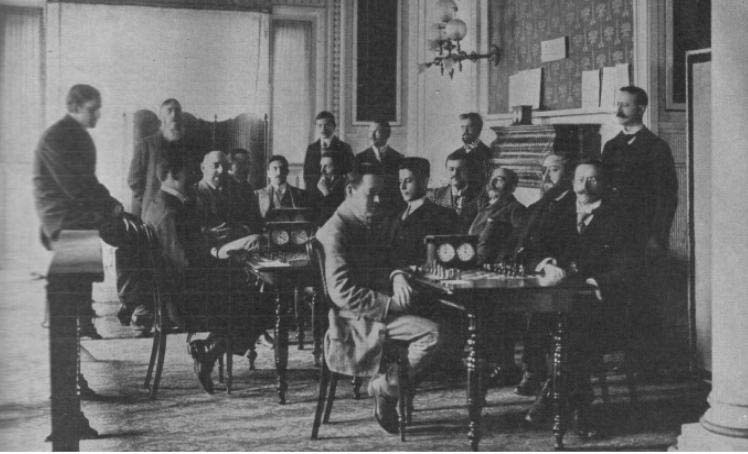
At the railing: Marshall. Standing: Burn, Leonhardt, Duras, Vidmar, Mieses. Seated (back row): Janowski, Bernstein, Schlechter, Rubinstein, Maróczy, Capablanca, Nimzowitsch, Hoffer, Teichmann. Seated (front): Spielmann, Tarrasch. (Public Domain / Wikimedia Commons)
Historical Significance
San Sebastián 1911 was one of the strongest tournaments in chess history: 9 of the world's top 10 players competed. Only World Champion Emanuel Lasker was absent — he married Martha Cohn in Berlin on March 7, 1911, and had declined his invitation early on. The only other notable absentee was Henry E. Atkins, the reigning British champion.
The qualification criteria were strict: only players who had won at least two third or fourth prizes at international tournaments were admitted. This threshold was designed to guarantee the highest playing standard — and it triggered the famous Capablanca controversy.
Stylistically, the tournament marked a paradigm shift: the romantic attacking school of the older generation — represented by Dr. Siegbert Tarrasch, Burn, and Janowski — clashed with the positional, economical play of the younger masters: Capablanca, Rubinstein, and Nimzowitsch. The 22-year-old Capablanca's victory symbolized the triumph of the new school.
The Capablanca Controversy
Capablanca did not meet the formal qualification criteria — his only international success was his match victory over Marshall in 1909. His invitation was carried by that victory and by his status as the field's only "Spaniard" (Cuba had still been a Spanish colony at his birth in 1888); the Capablanca literature additionally names the Cuban diplomat Manuel Márquez Sterling as an influential patron who lobbied for his compatriot.
Ossip Bernstein formally protested Capablanca's inclusion. A persistent rumor claims Nimzowitsch also protested — but as André Schulz (ChessBase, 2021) has documented, there is no evidence for this.
A Note on the Sources
The tournament patron named "M. Marquet" in the contemporary press is identified in recent literature (following Miguel Sánchez, as reported by André Schulz, ChessBase 2021) with Manuel Márquez Sterling. This identification is incompatible with the documented biography of the Belgian casino entrepreneur Georges Marquet (1866–1947), director in Ostend and San Sebastián (Revista San Sebastián 2016; Hartford Courant, 3 February 1911). Sterling's possible role as a patron behind the scenes remains untouched by this correction.
Before the tournament began, blitz games were played in which Nimzowitsch attempted to put the young Cuban in his place — only to be dominated by Capablanca. Poetic justice came in Round 1: Capablanca defeated Bernstein himself in a brilliant game and was awarded the brilliancy prize (500 Francs, donated by Baron Rothschild).
Final Standings
| # | Player | Country | Score | +/=/− | Prize |
|---|---|---|---|---|---|
| 1 | Capablanca | Cuba | 9½/14 | +6 =7 −1 | 1st Prize, 5,000 Fr. + Brilliancy Prize 500 Fr. |
| 2–3 | Rubinstein | Russian Empire | 9/14 | +4 =10 −0 | 2nd/3rd Prize shared |
| 2–3 | Vidmar | Austria-Hungary | 9/14 | +5 =8 −1 | 2nd/3rd Prize shared |
| 4 | Marshall | USA | 8½/14 | 4th Prize, 1,500 Fr. | |
| 5–7 | Dr. Tarrasch | German Empire | 7½/14 | ||
| 5–7 | Schlechter | Austria-Hungary | 7½/14 | ||
| 5–7 | Nimzowitsch | Russian Empire | 7½/14 | ||
| 8–9 | Bernstein | Russian Empire | 7/14 | ||
| 8–9 | Spielmann | Austria-Hungary | 7/14 | ||
| 10 | Teichmann | German Empire | 6½/14 | ||
| 11–12 | Maróczy | Austria-Hungary | 6/14 | ||
| 11–12 | Janowski | France | 6/14 | ||
| 13–14 | Burn | Great Britain | 5/14 | ||
| 13–14 | Duras | Austria-Hungary | 5/14 | ||
| 15 | Leonhardt | German Empire | 4/14 |
Rubinstein was the only undefeated player (4 wins, 10 draws). Non-prize winners received 80–100 Francs per point scored.
Sources: chessgames.com; Robert Irons, San Sebastian 1911 (Russell Enterprises, 2024)
The Famous Quote
"Lasker's style is clear water, but with a drop of poison in it that makes it opalescent. Capablanca's style is perhaps even clearer, but it lacks the drop of poison."
Often misattributed to Spielmann. Edward Winter documents in Chess Notes (C.N. 3161) that the original source is unambiguously Mieses — proven by the reprint in the tournament book.
Prize Fund
| Placing | Prize Money |
|---|---|
| 1st Prize | 5,000 Francs |
| 2nd Prize | 3,000 Francs |
| 3rd Prize | 2,000 Francs |
| 4th Prize | 1,500 Francs |
| Brilliancy Prize (Baron Rothschild) | 500 Francs |
| Non-prize winners | 80–100 Francs per point |
The Tournament Book
Mieses and Dr. Moritz Lewitt authored the official tournament book: Internationales Schach-Turnier zu San Sebastian 1911 (1st edition: Verlag Dr. Wedeking & Co., Berlin, 1911, 128 pp.; 2nd edition: Hans Hedewig's Nachfolger, Leipzig, 1919, 162 pp.). All 105 games with Mieses' annotations.
In 2024, an English edition appeared: Robert Irons, San Sebastian 1911 (Russell Enterprises/New In Chess, foreword by Andy Soltis).
More about the tournament book →Sources
- Mieses, Jacques & Lewitt, Moritz: Internationales Schach-Turnier zu San Sebastian 1911, Verlag Dr. Wedeking & Co., Berlin, 1911
- Irons, Robert: San Sebastian 1911, Russell Enterprises/New In Chess, 2024
- Hooper, David & Whyld, Kenneth: The Oxford Companion to Chess, Oxford University Press, 1992
- Winter, Edward: Chess Notes – C.N. 3161 (Mieses quote on Lasker and Capablanca)
- Schulz, André: "San Sebastián 1911", ChessBase, 2021
Other Tournaments
International Debut Breslau 1889
3rd Prize – first international master tournament Hastings 1895
Tournament of the Century Berlin 1897
Shared 3rd–4th Place Monte Carlo 1903
8th Place Cambridge Springs 1904
8th–9th Place Vienna 1907
1st Place – Greatest Victory! Ostend 1907
3rd–4th Place – World-Class Event San Sebastián 1911
Mieses as Organizer Liverpool 1923
1st Place – Tournament Victory! Baden-Baden 1925
New Beginning After War Kemeri 1937
The Fateful Tournament Chess Olympiads
London 1927 · Prague 1931
Did You Know?
Capablanca sailed to Europe on February 8, 1911, aboard the Lusitania — the same ship that would be sunk by a German U-boat four years later.
Chess journalist James Mortimer died during the tournament in San Sebastián.
The Grand Casino (opened 1887) is today the City Hall (Ayuntamiento) of San Sebastián.