On the Death of Senior Grandmaster Jacques Mieses
An Obituary for Jacques Mieses
Jacques Mieses died on February 23, 1954, in London, shortly before his 89th birthday. This German-language obituary appeared shortly afterwards; the publication has not yet been identified. The likely candidate is the magazine SCHACH, published in Berlin from 1947 — Richter's own Deutsche Schachblätter can be ruled out, having ceased at the end of 1952. The initials (K. R.) suggest Kurt Richter, the renowned Berlin chess master and journalist.
On the Death of Senior Grandmaster Jacques Mieses
1954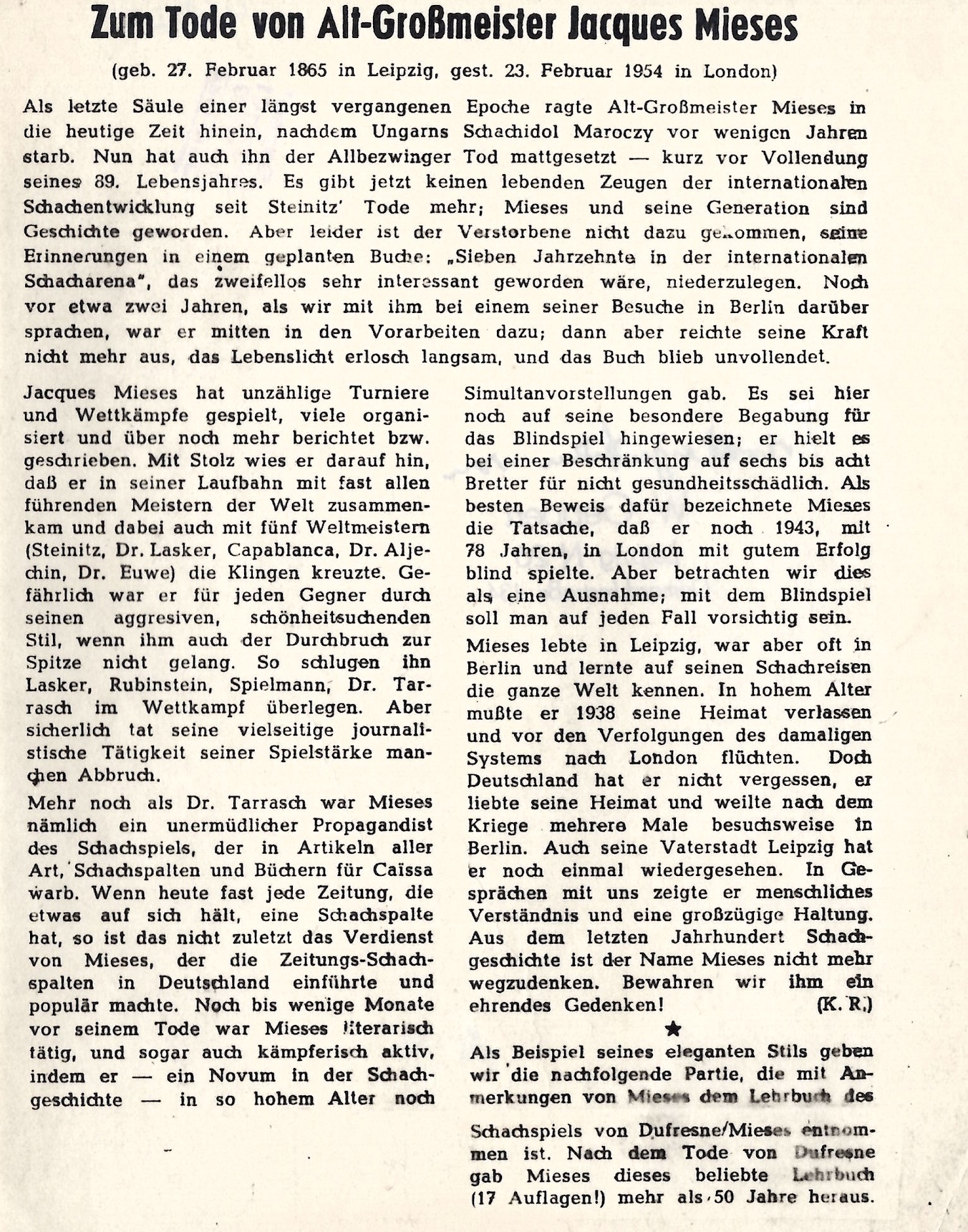 Click to enlarge
| Publication | Unknown (German-language newspaper/magazine) |
|---|---|
| Date | 1954 (after February 23) |
| Language | German (Original) |
| Type | Obituary |
| Occasion | Death on February 23, 1954 in London |
| Author | (K. R.) — presumably Kurt Richter |
The obituary honors Mieses as "the last pillar of a long-gone era." After the death of Hungarian chess idol Géza Maróczy a few years earlier, Mieses was the last living witness of international chess development since the death of Wilhelm Steinitz (1900).
With his death on February 23, 1954 — shortly before completing his 89th year — an entire generation became chess history.
A previously unknown piece of information: Mieses was planning an autobiography titled "Seven Decades in the International Chess Arena".
About two years before his death — during one of his visits to Berlin — he was in the midst of preliminary work on this book, which "would undoubtedly have been very interesting." But his strength was no longer sufficient: "the light of life slowly faded, and the book remained unfinished."
Five World Champions
Mieses proudly pointed out that during his career he met almost all the leading masters of the world and crossed swords with five world champions:
- Wilhelm Steinitz
- Emanuel Lasker
- José Raúl Capablanca
- Alexander Alekhine
- Max Euwe
His aggressive, beauty-seeking style made him dangerous for any opponent, even though he never broke through to the absolute top. In matches, he lost to Lasker, Rubinstein, Spielmann, and Tarrasch.
"Even more than Dr. Tarrasch, Mieses was a tireless propagandist of chess," promoting Caissa through articles, chess columns, and books.
His lasting legacy: Mieses introduced newspaper chess columns to Germany and made them popular. That almost every newspaper today has a chess column is largely his achievement.
Just a few months before his death, he was still active as a writer and — a novelty in chess history — gave simultaneous exhibitions at such an advanced age.
The obituary highlights Mieses' special talent for blindfold chess. He considered it not harmful to health when limited to six to eight boards.
As the best proof, Mieses cited the fact that he still played blindfold in 1943 at age 78 in London with good success.
Mieses lived in Leipzig but was often in Berlin and got to know the whole world through his chess travels. In 1938, at an advanced age, he had to leave his homeland and flee to London from the persecutions of the Nazi regime.
Yet he never forgot Germany. He loved his homeland and visited Berlin several times after the war. He also saw his native city of Leipzig once more.
The author describes Mieses' "human understanding and generous attitude" in conversations
about the difficult past.
Chess in Exile
The Chess Textbook
The obituary concludes with a reference to the famous Lehrbuch des Schachspiels (Chess Textbook) by Dufresne/Mieses. After Jean Dufresne's death, Mieses edited this popular textbook for more than 50 years — it reached 17 editions.
The initials (K. R.) at the end of the obituary suggest Kurt Richter (1900–1969):
- Berlin chess master and journalist
- Known for his tactical, combination-rich style
- Author of numerous chess books
- Edited the 19th edition of the Dufresne/Mieses textbook
The personal tone of the obituary — "when we spoke with him during one of his visits to Berlin" — confirms the close connection between Richter and Mieses.
Comparison with the BCM Obituary
This website also features the English-language obituary from the
British Chess Magazine (April 1954), which illuminates other aspects of Mieses' life.
Read BCM Obituary